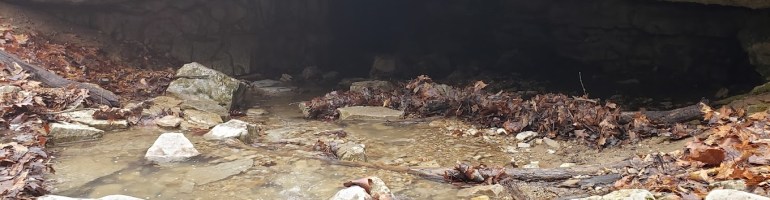
When I was a kid our family often spent weekends camping at McCormick’s Creek State Park. The park has a variety of hiking trails and other attractions, but the one I was most drawn to was Wolf Cave. According to the park’s website “Wolf Cave was formed as underground water dissolved the limestone bedrock and carved out a network of passageways. Over the years Wolf Cave became exposed by the powerful forces of erosion. The cave is now dry because the underground stream it once carried has carved lower passageways.”
While I trust this explanation of the cave’s origin, as a kid all I knew was this was a “way cool” cave that you could actually go through from one side to the other. If memory serves, the opening of the cave – which is rather broad and squat – invites you to enter on bended knee. Through travelers are quickly funneled from the breadth of that opening into a single file channel of rocky outcrops and curves. The close formed ceiling of the cave causes you to watch your head (learned that the hard way), while the mud packed floor bids creeping footfalls that are sometimes accompanied by the suction of water. All of this is enhanced by total darkness, perhaps pierced by a flashlight if you were fortunate to have planned ahead.
I’m not sure my age when I first ventured through the cave, but I doubt I was yet ten years old. I do remember keeping touch with older siblings who were both ahead and behind me, and having the sensation of wanting to turn around more than once. That, however, was not an option for more than one reason. First, there were multiple people in line behind us and crawling back against that current of strangers was a foreboding thought. Second, the humiliation of turning back without completing the mission would have forever stained my reputation and self-esteem. (Who am I kidding, I wasn’t thinking in those terms. I just didn’t want to be called a “sissy” by my family!)
So, we pressed on. The confined passageway eventually yields to a more spacious great room at the cave’s opposite end. However, to exit that room back into the great outdoors one has to crawl through a small opening – which (as luck would have it) was filled with rain water on my pilot spelunking adventure.
This memory of the first of several trips through Wolf Cave in my childhood and adolescence, has served as a metaphor on occasion for adult life comparisons. Life has a way of presenting us with obstacles – some anticipated but many not. These obstacles, whether they are physical, mental, spiritual or emotional can create similar feelings to the claustrophobic regret and second thoughts I encountered mid-trek through Wolf Cave. Should you press on, going forward even though you know it’s going to be challenging? Or, should you turn back, and retrace your steps?
As with my decision at Wolf Cave, many times “going back” just isn’t an option. It might even be disastrous to try. For example, you cannot “go back” when a loved one dies. Grief will be hard, but it is a forward leading endeavor. You usually cannot “go back” to a job you’ve left, even if the new one doesn’t work out. There were likely reasons you left that job. Going back, those reasons would quickly surface.
It’s tough to “go back” to the way things were when a relationship has been challenged by mistrust. You may be able to “go forward” and rebuild something, but trying to go back without dealing with the issues would likely prove disastrous. The same holds true with big disappointments. Regardless of how they came to be, white washing them away in an effort to “go back” may prove more difficult than doing the hard work of forward movement in overcoming.
Just consider the many life passageways for which this holds true. Leaving home as a young adult can be hard, but going back might be disastrous. Giving birth is hard, trying to go back – not an option. Growing up has it’s challenges, returning to childhood – virtually impossible.
So, whatever it might be in your present that feels, or is, hard, causing you to want to “save face” or “retreat” and “find refuge in the familiar”; if that’s not an option, why not consider how you can move forward? It just might open up a passageway you’ve heretofore not been able to see or imagine.
 danielcash
I enjoyed reading this. Puts things