This morning I began my day with some time in Psalm 47 and a prayer guide titled The Songs of Jesus by Timothy Keller. Psalm 47:1 says: Clap your hands, all you peoples; shout to God with loud songs of joy. In his reflection on this psalm, Keller writes: “Rather than think of ourselves as an embattled, political minority or persecuted underdogs, Christians should be so over-flowing with the joy of our salvation that we feel the privilege of singing his praise to those who do not know him.” (p.98 The Songs of Jesus)
As Christ followers we serve and follow a risen Savior. He is King Jesus, the One who overcome sin and death. His resurrection, celebrated just last Sunday, makes it possible for you and I to know joy. We can know the joy of our own redemption from sin. We can know the joy of abundant life in Christ. We can know the joy of a promise of eternal life with him when, one day, we enter into our life after death. In short, there is so much to be joyful about.
Yet how often do we project a different message through our countenance, our words, or our behavior? When we go through life long-faced, despondent, complaining or piously encumbered, we act more like that “embattled minority” Keller counsel us to avoid representing. My experience of Easter this year was joyful, was yours?
*Note: This blog post is also available as a podcast on “Dan’s Sunday Preview“, a podcast by Pastor Dan Cash which can be accessed at https://anchor.fm/daniel-cash, Apple podcasts and a variety of other sites.
Growing up in a Christian home, Holy Week was a time in the Christian year when I was reminded that as Baptists, we were not alone in this journey of faith. You see during Holy Week we came together for a series of “special services” with our Methodist and Disciples of Christ brothers and sisters to commemorate the season.
These three congregations in my home community took turns hosting one of three special services – Maundy Thursday, Good Friday or Easter Sunrise – providing special music and preaching on the occasions when they weren’t serving as host. I found the whole enterprise to be quite interesting. Sitting in the pews in another congregation was a new experience. Seeing people from the greater community who were members there, or at another church. Listening to another preacher – my favorite was the Methodist pastor because he never preached longer than 15 minutes! In contrast it seemed like our pastor couldn’t wind it down under 30!
I was not raised in a family or faith tradition that observed the season of Lent. As Baptists we were what some might call “low church” or of the “free church” tradition. That is to say the liturgical calendar, aside from Easter and Christmas, was not something we consulted on a regular basis. As for Lent, as I’ve often said, that was something you cleaned from the dryer trap.
Upon attending seminary and serving a Chicagoland church as a seminary intern, I learned about the Church Year and had opportunity to participate for the first time in the Lenten season. I learned that Lent was a period of 40 days, plus 7 Sundays, largely patterned after Jesus’ 40 days of temptation in the wilderness. I learned it was a time of spiritual preparation and reflection leading up to Easter. I learned it wasn’t something weird or other, but rather a season in which I could take on some spiritual practices in prayer, study or even mission to focus my own discipleship.
The church I served in seminary had a tradition of holding an annual Lenten Arts series. This was a time when some aspect of the fine arts were displayed in the sanctuary and became part of our worship space. One year it was art from a local sculptor. Another year we borrowed paintings of Jesus’ twelve disciples to display. This was a further enhancement of my experience with the season, and a good reminder – especially for someone who is word focused – that other media can speak to us. I remember studying the faces of the disciples during those Sundays and thinking about what they must have experienced with Jesus.
Today it has become more common for those of us from the “low/free” church tradition to acknowledge and observe the seasons of the Church year. As an American Baptist pastor, who has often felt I have one foot in the mainline and the other in the evangelical traditions, the Lenten season has become one I not only lean into, but encourage congregants to as well.
For me it’s not so much a focus on giving up something for the season, although that’s a fine practice if it works for you. I prefer to think about what practice I might “take on” for Lent. Usually that means reading through one or more devotional books, or changing a prayer pattern for the season, or engaging in some type of mission focus (beyond normal duties). The possibilities for such practices are truly endless. Especially during this ongoing pandemic, it might be meaningful to take on a practice of connection with someone who is isolated; or a good deed to one who needs extra help during the challenges of winter’s snow, ice and cold.
The hope is that these Lenten practices can help us to see life, see others, and see Christ with eyes that are refreshed or refocused. When we live beyond ourselves – helping others, praying for others, connecting with others – we engage in the acts of Christ who called us to love one another. That’s something worth leaning into, not just for a season, but for a lifetime.
What are you hoping for in the new year? Have you been thinking about that? The past few days have been filled with people saying how glad they will be to see 2020 go, moved to the year view mirror, or made a distant memory. Those are the sentiments the misery of facing a global pandemic will churn in us. If only it were as easy as turning the page on the calendar. Sadly, disappointingly, we’re likely to awaken to a 2021 that looks a lot like the end of 2020. I don’t mean to be a Daniel Downer, and I am optimistic that 2021 is going to eventually bring a brighter future, it’s just going to take a while.
So, realistically, what are your hopes for 2021? I’ve heard things like “being able to hug my (fill in the blank) – Mom, Grandma, grandchildren, neighbor . . . Having never been one that was too keen on hugs I’d have to say this one is not that high on my list, but I can understand the sentiment behind it. We’ve had to be so distanced from one another this past year, the need for compassionate touch is real. Handshakes, fist bumps, side hugs and even bear hugs will be welcomed (for the most part) in 2021. I envision a day when we can have a big facemask bonfire, shake hands at church again, and serve each other communion (though perhaps those things do not happen all together).
What else might we be hoping for? Speaking of church, I’m hoping for the resumption of in-person worship. We did 20 weeks of online only worship in our congregation in 2020 and we will begin 2021 that same way. I have not seen some people face to face since early March of 2020. While I am thankful for the ability to be connected in that way, I’m ready to see people in the pews again. Aren’t you?
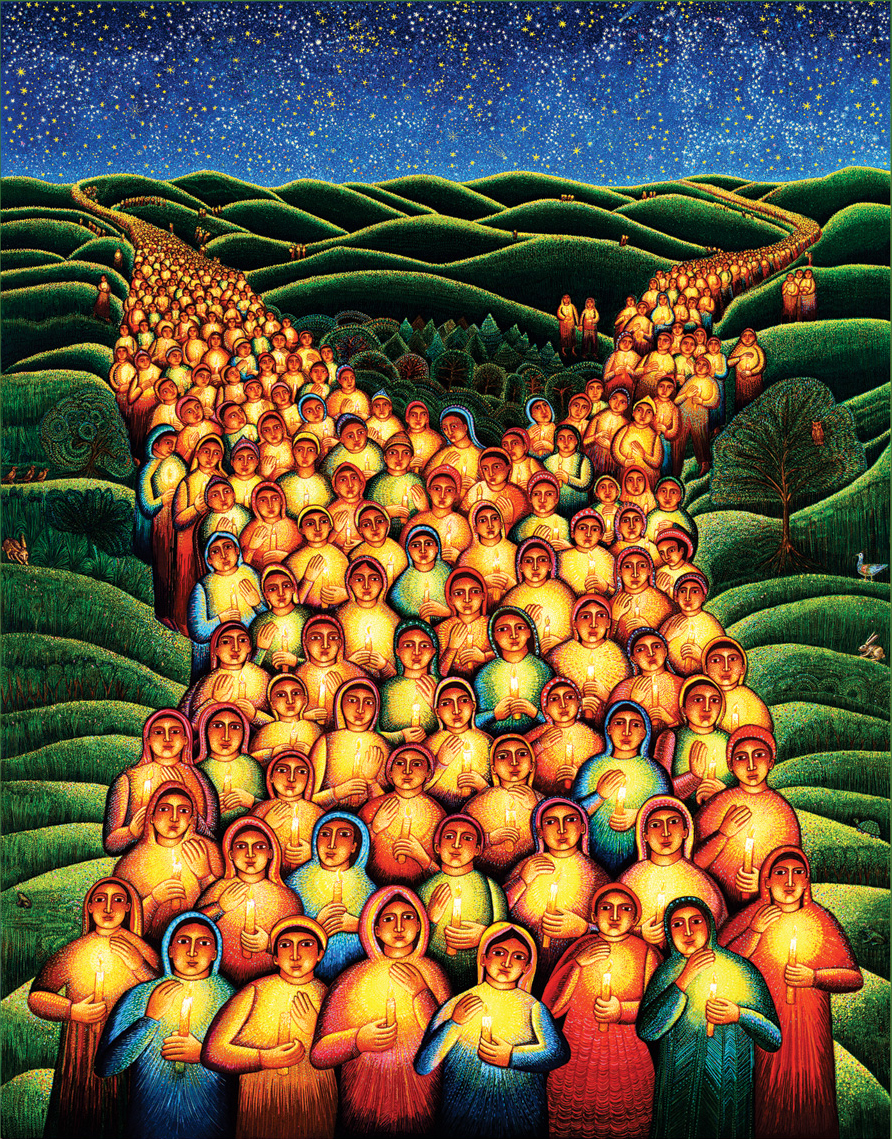
There’s something about candles, candlelight services, and candle lit spaces and Christmas. The soft glow of a candle’s light brings an inviting warmth to a space and a moment. Candles held, lit and clustered together in procession or praise offer an ambiance unlike any other. I have early memories of attending Christmas Eve candlelight services, longing to be old enough to be trusted with my own candle. It was a right of passage, that moment, not just of age, but of responsibility and privilege to add my own small light to the collective whole. I was represented in that light, offering worship to the newborn king.
The candlelight Christmas Eve service remains one of the most cherished of the year. It’s a congregation unlike any other all year. People typically arrive at the last moment – rushing from family gatherings and celebrations to be there just in time. Those gathered are a combination of out of town family, neighbors and community folk looking for a Christmas service, and faithful congregants who help “swell the crowd” on a weekly basis. With many of our own having traveled elsewhere, the Christmas Eve congregation often has a newness about it. These are people whom I don’t know all that well – including a few who were drug along by insistent relatives, notably uncomfortable with the idea of singing or praying. They don’t linger long after the service. But when it comes time to light the candles, everyone participates and with enthusiasm. Why is that?
Sure, there is the peer pressure of the moment. You wouldn’t want to be the dud who refused to light your candle. You’d stick out like that half-strand of lights that went out on the tree at home. And there is the emotion, drawing us in like a baby’s smile or Grandma’s sugar cookies. But I’m want to think there’s something else – something akin to what awkward shepherd’s felt as they journeyed to Bethlehem to see the babe in the manger. It’s something like what regal wise men demonstrated on their later homage to the new king. We have, in our humanity, a need to acknowledge and worship the Christ.
Holding that lit candle, if only for the duration of a few verses of Silent Night, transports us into the presence of the Light of the World. And, we too, want to shed a little light; and add our lumens to those of many others in corporate recognition that this Light shines upon us and the world we call home. This Light burns in our heart – always, often, or only on this night. This Light floods the dark corners of our selves and reveals that God knows it all, sees it all, yet loves us and comes to redeem and restore us. This light, shared in collective worship, appeals to God on behalf of the world God loves for peace, hope, healing and restoration.
How can a simple lit candle, held aloft in unison with others, represent so much? What will it represent for you this year? Many a Christmas Eve service, including our own, will be held virtually in 2020 as this horrid pandemic keeps us physically apart. But I hope we will each light our Christmas Eve candles as we worship. Perhaps we will even share their light with our neighbors – finding ways to light the windows of our homes or lighting luminaries on the sidewalk or driveway. Our light(s) will be our witness to the hope of Christ for a broken and sick world, to the promise of redemption for all of our sin-sick souls.
So, fret not, you who are mourning the loss of tradition – including the Christmas Eve service as we’ve known it. Think not of what is being lost, but of what is being kept and perhaps shared in new ways. Hold your candle high and know that in its solitary light, it joins in solidarity with a multitude of other lights to show the way to Bethlehem.
Come, O house of Jacob, let us walk in the light of the Lord! (Isaiah 2:5).
*The picture that accompanies this blog is called “Festival of Lights”. As with all great pieces of art, there is a story behind it. If you are interested in learning more about the painting and artist’s thoughts watch this video.