His AKC registered name was “Hogan’s High Dollar Boomerang” but we knew him as “Boomer”. His sire was an award winning Welsh Pembroke Corgi, so he came from good stock. Sadly, he succumbed to lymphoma at the age of 9.
When we adopted Boomer at the tender age of 8 weeks we were not looking for a show dog, just a family dog from a breed we had enjoyed before. He was our second Corgi, little short-legged dogs with big dog attitudes, best known as the preferred dog of the Queen of England. High energy, herding instincts, loyalty, curiosity (some would say “nosey”) are all characteristics of this breed. Boomer had them all.
He spent countless hours looking out the front window of our home, watching over the neighborhood, alerting us if something was slightly different. He had his nemesis’ – the squirrels that ran the fence tops of the back lawn, chucking at him with derision as he stood sentry, barking from below; and (for some reason) a certain greyhound who’s owner walked him past daily (never figured out what he took offense to there – maybe it was the long legs?). He faithfully chased rabbits away, nearly catching one or two young ones in the past, but uncertain what to do with them when he had them cornered.
Each of the Gospels has its own unique emphasis as it shares the Good News of Jesus’ resurrection. In John chapter 20 we are told how Peter and John ran to the tomb after Mary reported it was empty. Verse four says, “The two were running together, but the other disciple outran Peter and reached the tomb first.” Why was this detail of having arrived first, important to John? Did it give him bragging rights? “I beat Peter to the tomb!” I have often puzzled over this aside within the Easter story. On Easter there was a race and John outran Peter. It seems like the kind of detail one commits to memory around a life changing event. It’s the event that is important, but it’s importance is mirrored in the details that are remembered around it. For John, outrunning Peter was one of those details.
But they were not the first to run that morning. Backing up to verse two we see that Mary Magdalene was the first to run. She ran from the tomb to tell Peter and John what had been discovered: the tomb was empty. They ran to the tomb to verify her claim and see for themselves. Lot’s of running.
I love to learn new things. It’s part of my personality. Just about the only thing I enjoy more than learning something new is finding a way to practically share it with someone. I guess that is part of what drives my writing and speaking.
Recently I learned something new while on a day trip with my wife to the Falls of the Ohio State Park. This is a lovely little part located on the Ohio River in Clarksville, Indiana. It had long been a destination on a bucket list of places I wanted to visit but had not yet been to. I know, you may be questioning how exciting my bucket list is, but as one who had often driven past the signage for this park, I usually thought, “Someday I’m going to stop there.” So we did. In fact we went there on purpose.
My attraction to the Falls of the Ohio was from having read about this place of geography and its alignment with the story of Lewis and Clark and the Corps of Discovery, and prior to them it’s association with George Rogers Clark, the Revolutionary War hero and frontiersman for whom the city of Clarksville is named. You see the Falls of the Ohio is the place George Rogers Clark called home, and where Merriweather Lewis met up with William Clark (George’s younger brother) to begin their excursion to the great Northwest, a commissioned expedition of the United States government to explore the land of the Louisiana Purchase.
Had I been alive around the year 1800 I would’ve loved to have been part of the Corps of Discovery. Just imagine setting out from the Falls of the Ohio on a 3 year round trip journey, looking for a water passage to the Pacific, and discovering instead a formidable land/water route across the Rockies! I am sure the expedition itself would have proven vigorous and challenging beyond belief, but what I have read of it (see Stephen Ambrose’ book Undaunted Courage) is exciting. So, any chance I’ve had to see the sites visited by Lewis and Clark and their crew, in person I have embraced. This has included listening to Ambrose’s book while we moved from the Midwest to the Pacific Northwest, passing many of the landmarks along the way. I’ve imagined what it was like to set sail up the Mississippi to the Missouri River. I’ve envisioned the winter camp among the Mandan Indians, burying the cache of goods as they pared down their supplies to make an overland route. I’ve surmised what it was to discover and explore the Colorado River, to face the perils of the Northern Rockies in modern day Idaho, and to canoe the rapids of the majestic Columbia all the way to Fort Clatsop on the Oregon coast.
I’ve also thought about the mosquitos, the bitter cold and summer heat, the illnesses and injuries, the adventure and challenge each new turn in the journey brought. I’ve considered the human factors of traveling with people for that long, the different personalities, squabbles over authority and influence, and decisions that had to be made and followed. It’s a remarkable story, this story of the Corps of Discovery, with Lewis and Clark front and center – two friends and colleagues of very different skills and interests. And it all began at the Falls of the Ohio, which despite my proximity to – living just an hour north – I had never visited, until last week.
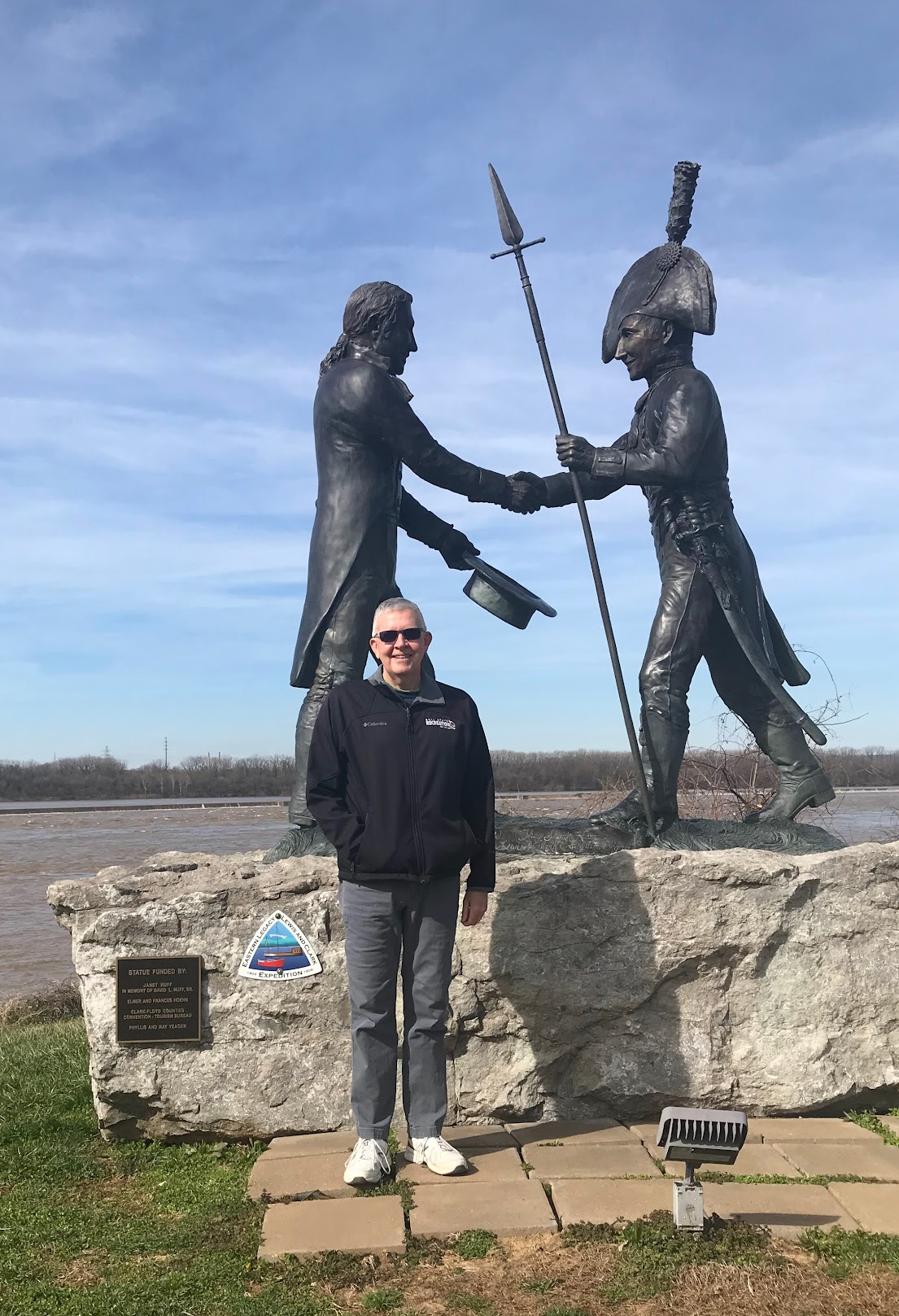
I knew there was an interpretive center at the State Park, the expected water views, and an obligatory statue of the sojourners (see picture). But I thought I was going to primarily visit the starting point of the Lewis and Clark story. Imagine my surprise to learn that the Falls of the Ohio is so much more. The interpretive center does a fabulous job of taking you through the history, geology and geography of this landmark – a roughly 26 foot drop in elevation over a series of rapids. It’s a unique place of geological preservation where fossils and artifacts of history can be found detailing a much longer story of the earth’s creation and evolution to present day.
We learned about ancient historic periods, including the ice age and it’s impact on the formation of the Ohio and its Falls. We learned of the natural human gathering place this landmark created, it’s influence on history, discovery and settlement of communities yesterday to today. Can I say I was both surprised and impressed? I was. It was the unpacking of a treasure trove of information that far exceeded the primary purpose of my visit. But it included information and imagination about that event in history as well. So there we were, at the very point of departure of Lewis and Clark, but also at a point of land where much, much more has been documented and studied and learned about.
Sometimes the best discoveries are those that are closest to home, or more than one hopes for. If you’ve not been, the next time you are about to cross over the Ohio river on I-65, take exit one on the Indiana side and give yourself permission to learn something new. I think you will be glad you did.
Lewis, Clark and Cash arriving roughly 220 years too late.
The Preacher of Ecclesiastes, commonly thought to be Solomon, writes in Ecclesiastes 3 “For everything there is a season, and a time for every matter under heaven“. He then proceeds to list the various things for which there is a time, including in verse 8: “a time to love, and a time to hate; a time for war, and a time for peace.” I must confess to having struggled with that next to last one over the years, and most especially again recently.
I do not understand the reasons Russia, and her autocratic leader Mr. Putin, would feel entitled to wage war against their peaceful neighbor Ukraine. I do not understand the aggression, the violence, the carnage, the hostility and death. It makes no sense to me. It is heart breaking to hear the voices and see the pictures of Ukrainians being forced from their homeland as refugees, and being forced to defend their nation as soldiers.
Many years ago when different war drums were being beaten on the world’s stage I remember discussing with a mentor in ministry how one who follows Christ should feel about this. His response, which has always stayed with me, was “I believe God is always sad when there is war.”
More than any other emotion it has been “sadness” that I’ve felt in response to the news reports, pictures and stories emerging from the ongoing invasion of Ukraine. Lives have been forever upended and altered because of this needless war.
I invite you to add your prayers for peace to those of the multitudes the world over who are engaged in intercession for the people of Ukraine, along with the people of Russia most of whom did not want this war either.
In his appeal to the member bodies of the Baptist World Alliance, General Secretary Elijah Brown said this: “As brothers and sisters within a global Baptist family, we are all called to be both peacemakers and people of prayer,” says Brown. “As one Baptist family rooted in Jesus Christ as Lord, we bear witness to the biblical truth that ‘if one member suffers, all the members suffer with it.’ It is vital for Baptists around the world to stand with those who are suffering and to fervently pray for peace.“
There are certain calendar dates that get your attention. You know what I mean, right? We all know the date 9-11-2001. Many of you remember 12-07-1941. What about 11-22-1963 or 04-04-1968? Those are the dates of John F. Kennedy’s and Martin Luther King Jr.’s assassinations. Then there is 1-28-1986? That’s the day of the Challenger’s explosion. What about 11-11-1918? That’s the date a cease fire was signed (at 11 a.m.) to stop the hostilities of WW I. Then there’s 5-8-1945 (VE Day) and 8-14-1945 (VJ Day or Victory in the Pacific Day). Every generation has it’s significant dates we commemorate. Some are great, some are sad, most are never to be forgotten.
When you add in your own personal dates, birthdates, anniversary dates, death dates of loved ones, we each have a number of dates we more or less keep track of. They may not be on our minds every day, but when that day rolls around on the calendar, we pay attention to it.
My wife teaches first grade. In first grade they keep track of days. For example the 101st day of school is a big day. It might be associated with 101 Dalmatians. The 180th day of school is an even bigger day – it’s the last day of school for the year. Lori told me that her class would be observing today’s date as well. It’s not often one comes across a date like 02-22-2022. That’s six “2’s”! One of our grandson’s recently turned 2 years old. I think he would be excited about all those “2’s” in todays day. Are you?
On March 2 the first graders always celebrate Dr. Seuss day – its the birthday of Dr. Theodor Seuss Geisel – he of the rhymes and writings of all things seussical. It also happens to be my birthday. I’m not too proud to say there have been years when I was not all that excited to share the day with a guy that has been dead for so long! I’m still trying to get over it.
What are the days and dates that you recall. My Grandma Cash always spoke of “old blue Monday”. Monday, it seems, was the day my Grandpa Cash, her husband, died. She commemorated that day of the week often in his absence. Do you have any days of the week like that? What about days of the month or year?
I have not always done a good job remembering dates associated with loved ones. FaceBook helps me remember birthdays now – sometimes a little too much! But I do remember my Dad’s birthday – 04-07-1929, and my Mother’s 03-08-1932. I could not, however, tell you when their Anniversary comes around – sometime in October.
Sometimes a date only means something to an individual or a handful of individuals. For example, I remember the date I started my current pastorate. My first Sunday was 11-11-2007. This past year I was surprised when a church member mentioned the day to me and told me she had it written on her calendar.
Sundays have always been dates that featured prominently in my memory. It stands to reason that pastor’s know the calendar dates of a year’s Sundays. They are kind of big days in our routine. What are the big days in your routine?
Maybe on this unusual day – 02-22-2022 – it’s a good time to reflect on the days and dates of your life. Give thanks for those that bring a smile to your face. Try to move past the ones that make you frown or worry or bitter. Most of all, thank God for today. There’s never going to be another one like it.