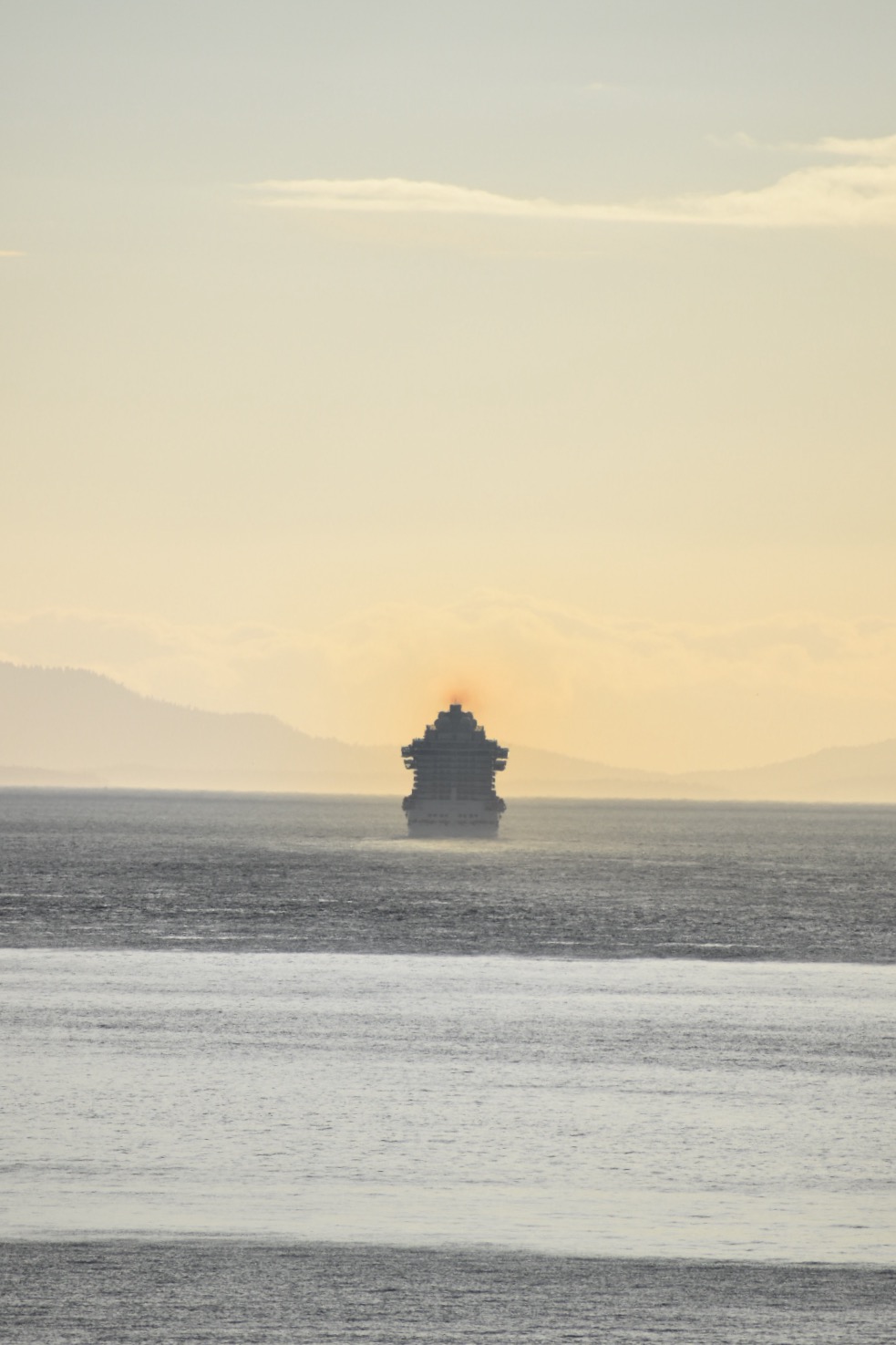
I imagine those who once sailed these waters off the coast of southeast Alaska, as I watch and photograph a cruise ship sailing ahead of our own into the distance and space of an evening horizon.
These were the lands and waters of the Tlingit (pronounced Klin-git) people long before they were home to Celebrity, Princess, Royal Caribbean, or Holland America lines. Other indigenous groups that called these waters, fjords, islands and sounds home included the Haida, Tsimshian and Eyak. Equally skilled with paddle and bow, they hunted and fished these places where now tourists by the thousands pull out cell phones and cameras to capture something native.
Could the native peoples, first nations as known in Canada, have imagined such huge floating vessels equipped with galleys, staterooms, casinos, bars and fine dining spaces? Could they conceive of the extravagance docking on shores of their homelands, passengers spilling forth to explore, shop, and go on excursions into the wild? Could they have fathomed the pallets of groceries even one such floating buffet might consume? The expanse in time and culture from these extremely different eras seems vast. Yet, here in common space these very different times and people collide. Alaska – the great land – has a history of human diversity that just keeps on diversifying.
In preparation for our cruise and my own exposure to Alaska I did some reading. James Michener’s Alaska was one volume, along with John McPhee’s “Coming into the Country”. Robert Service’s collected poems was a late edition recommended by a friend. I also revisited Jack London’s “White Fang” and “The Call of the Wild” for good measure. The cumulative appreciation of such reading was the many cultures and peoples who had once called the land home. From the historic travelers of Asia’s land bridge, to the Aleutians, Athabaskans and Eskimos, this great land has known settlers of many stripes. The Russians, British and Americans would all lay some claim to this frontier. Evidence is seen in the settlements yet today. Names like Sitka, Ketchikan, and Juneau bespeak the influence of people from outside.
Nationalities and ethnicities were but one differentiation of said occupants. Vocation and trade offered another. Fisherman, frontiersmen, gold seekers, stampeders, entrepreneurs, missionaries, brothel madams all brought color and context to the great frontier. They came by ship, overland by dogsled, rail and auto, and eventually by air. They kept coming, and they keep coming today. What brought them? Salmon, the goldrush, the wilderness, oil, the hope of disappearing, the bush, the challenge, the mountains, the ocean . . . . What? Curiosity. Opportunity. Possibility. Those things that have driven human exploration, migration and settlement again and again.
Many who came, left. Not just after a 10 day cruise or two-week wilderness adventure. They left after a failed gold claim, or a bitter winter, or the bite of isolation, the hardness of darkness, the near extermination of their kind. The great land was too vast, too big, too much.
Others, of course stayed. We met some of them. They work as bus drivers, tour guides, and merchants. Many are seasonal residents, others seasonal in their approach to occupation. Tourist season means income. Off season must mean peace. To have the land back.
They’ve come to terms with permafrost and long distance grocery shopping. They tolerate the annual invasion of cruise ships and doppelganger wannabees who arrive with their fishing and hiking poles. Some inconvenience is necessary if one is to monetarily survive in the great land. They stay for the space, the silence, the off season, the distance from it all – civilization, regulation, modernization.
Like Captain James Cook and his pursuit of a Northwest Passage, or Sam McGee (not really of Tennessee) who was caught up in the Klondike, not so much a stampeder as a road builder, many of us have just passed – maybe sailed through this land. We’ve seen no more of Alaska – the great land – than a thumbnail. Yet we’ve been smitten by her nonetheless. If fortunate we are a 30 percenter who actually got to see Mt. Denali. Most of us belong to the 70 percent who did not. But we know it’s out there – standing tall and guarding this vast land. It’s a sentinel to another time, another place, and another people.
These are my thoughts as I focus on the ship that sails away to the distance. Where does it go? Who does it carry? Americans? Europeans? A mostly Indonesian crew with Dutch captain?
Will it cruise to Glacier Bay? College Fjord? Prince William Sound? The Cook inlet? Or beyond?
Alaska represents the great beyond, the great land, that to which one sails away. “Come sail away”, she says. “Come, sail away to me”. Then, sail away again.
 danielcash
Dan, you needn’t be in a hurry to return the Robert Service book, I’ve got another. I hope that you truly enjoyed Alaska. Are you ready to return yet?
It was a great trip. Am enjoying the book as well.