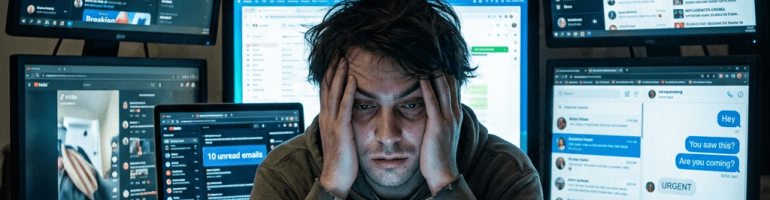
The era that we live in today has been described as 24/7/365. This means that not only is life happening in a 24 hour, 7 day a week, 365 day a year never-stopping pace; it is also being reported on, recorded and shared in those same increments. With the advent of the 24 hour news channel by CNN in 1980 it became possible to know what was happening in other places around the globe in real time. Eventually CNN’s competitors (FOX and MSNBC – both in 1996) added their own 24 hour news channels. These were greatly accelerated by the development of the Internet and Social Media. The result is that today it’s nearly impossible in much of the modern world to not be “in the know” about events of major impact, and even those of less than major impact.
But when is too much, too much? That’s a question I’ve been asking myself for quite a number of years now. Is it healthy to “always” be in the know “in real time”? Should one “always” be available? Could there be such a thing as too much exposure to what is presented as “news” or newsworthy? Is it all really worthy of consideration as “news”? Some of it seems to be more akin to gossip or blather. And what about availability to work? Does that client or co-worker, or supervisor really need access to you all the time?
As a pastor who made home visits, I became aware that several parishioners would have their television tuned to one of the aforementioned news channels much of the day. From morning till night there was the constant, oft repeated series of “stories” being reported by someone from behind a news desk. Variations of this format, of course, developed beyond the desk, to reporters free standing while telling us what they are going to tell us, then telling us, then telling us what they told us. Panels of “experts” would emerge to further disect and debate the “news”. Officials from government or business would be interviewed to offer their “take” on the story. “Breaking News” would scroll along the bottom of the screen, offering summations of that day’s “big” stories. And it would go on like this ad neausium all day and night, never stopping, but flowing into the next day with it’s “emerging” stories to supplement or supplant those of yesterday.
With the growth of the internet, websites, and social media platforms, access to the “news” has only multiplied. You can get “notifications” on your smart phone when “something” happens. Your pocket or purse will chime or vibrate, drawing your attention to the latest notice. And, if you are not careful, you will display a Pavolivian response to such electronic stimuli. In short, there is no escaping the news today, if you are even modestly plugged into the communication mediums that are offered through current technology.
For some who are isolated or lonely, the news readers and social media post-ers become almost like “friends” or “family”, bringing tidbits of audio and video, words and worry into their lives as consumers. You can even have a relationship with Siri, Claude, or Gemini through today’s avaialable AI techno platforms, diminishing real human contact or conversation even further.
In households where there are more than one inhabitant – say a married couple, or family – the pattern of evening discussion around the dinner table, followed by engagement together over a favored television program or family activity has yeilded to smart phone scrolling and multi-tasking with various screens. Sure, it’s not all “news” but it is dominating and shortening or altering attention spans. So much so that longform reading has suffered among the general populace to the point where even our “leaders” are reported to need things “dumbed down” in order to comprehend.
When is it too much? By my measurement we’ve long passed that threshold. The issue is not avoiding an overexposed status, but learning to back away from it (overexposure) toward something more healthy and balanced. Interestingly local school systems seem to be recognizing this need as several now require students to lock up their smart phone for the academic day. Will the same be true in industry, business, health care and higher education? Or will the addicted among us protest and demand their rights? Time will tell.
In the Gospels we often read of Jesus going off by himself to a quiet or deserted place to pray. Granted, he didn’t have to contend with a smart phone, or cable news, or social media apps; but he was often overrun by people and their need of his attention. Still, despite his busy and demanding schedule, he set boundaries and gave priority to his own spiritual and mental health by engaging in these times of apartness. Could there be a model here for us these many years later?
Boundaries of this nature are almost never effective unless they are self-imposed. There has to be the recognition from within that one needs to set boundaries on his or her availability, or access to what is passed off as “newsworthy”. Setting those boundaries is an important first step toward recovery of self and solitude. But that step needs to be followed by other steps. What, for example, will occupy that time and space once a boundary has protected it? For Jesus, the occupying focus was prayer or communion with God.
That seems like a worthy goal and partner. It might be companioned by uninhibited time with loved ones for conversation or presence. There is worth in setting aside time for personal exercise, mental acuity (reading) and other interests. Think of it as “replacement therapy”. You are replacing the tech addiction with something of a more healthy and helpful outcome – which may mean locking up the smart phone, turning off the computer or television and going silent. It might mean walking the dog without your earbuds and listening to the birds.
It’s amazing what you will hear when there is only silence. You will learn to hear the yearnings of your heart. You will hear the peaceful presence of nature, the hum of a quiet house, the inner beating of that heart. You might even learn to hear what the Lord is whispering to you and how God is calling you. So much becomes heard when we have the courage to eliminate some of the noise, once again taking control of the various inputs available to us.
Here’s an exercise you might try to assess if you are in need of affirming new boundaries in your own life:
– For 24 hours, track the number of times you look at your smart phone (pulling it up to your face and checking it). What’s your #?
– Try limiting your “news intake” to just one medium a day for a week. (Maybe that’s the evening news on TV, or reading a news
source online, or listening to a news app). How did you do? How did it feel?
– Be intentional in that time of day or week when you are with your loved ones and friends, to set aside your access to social media
or other internet access. Invite your friends to join you in this. (Substitute conversation, or just being together). What was that
like?
– Try starting your day with prayer or meditation before you ever access any type of a screen. (You might even use a hard cover
Bible or other resource and not a Bible App). What do you notice?
I’d love to hear if you do any of the above what you learn from it.

