Category Archives: Family

New Book Release: Dakota Dreams and Hoosier Homeland by Daniel M. Cash

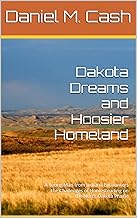
My latest book, Dakota Dreams and Hoosier Homeland, a work of historical fiction, has been and is available in paperback and e-reader format on Amazon.com. You can listen to my podcast about the book, featuring the book’s Prologue read in my own voice, on my Substack page. You can also read the Prologue below.

Dakota Dreams and Hoosier Homeland is the story of Clyde and Anna Cash, my paternal grandparents, set in the year 1915 between the communities of Greencastle, Indiana and Arnegard, North Dakota. My grandad Clyde tried his hand at homesteading at about that time in history. And, while I do not know all the particulars to his story, I have researched enough to have created a story that may represent some of the challenges and opportunities he faced. Meanwhile, back home in Indiana, his girl Anna (my grandmother) was patiently, or maybe not so patiently, waiting for Clyde to come to senses and come home. It was fun to imagine their correspondence and decision making.

The Dakotas will always have an imprint on my life, not only because of my grandad’s legacy, but due to my own time there over 100 years later. Writing this book became a way for me to to not only tell part of Clyde and Anna’s story, but to reflect on my own.

Here’s a preview from The Prologue of
Dakota Dreams and Hoosier Homeland:

When Clyde awoke on that early autumn day, he sensed the smell of smoke in the air. By now he had been on the prairie long enough to have heard about the dangers of prairie fires. Following the alert his senses gave him, he quickly went outside to scan the horizon.  To the southwest he saw a plume of smoke rising from above the land. It was the Lucas Johansen place. Lightning from the early morning storm must have ignited the fire.

Clyde wasted no time. He quickly dressed, grabbed an old blanket from his home, stepped into his boots and put on his hat, then high tailed it down the two-track from his place to the Johansen’s.  He jogged more than walked the ½ mile to their farm and saw on his arrival that the fire lay south beyond the homestead and barn lot.

Thankfully, Lucas and his brothers had already harvested the wheat crop earlier in the season, but the fire was making it’s way through the wheat stubble, threatening to move into the portion of the farm where the buildings stood.

Clyde took his place alongside the others, Lucas and Mrs. Johansen; Karl and Hans; Magnus and Marit.  He dipped his blanket into the bucket of water that had been hauled out to the field and commenced to fight back the flames where there was a gap in the line. Soon he was joined by his neighbor and good friend, Thomas O’Brien, who had also seen and smelled the smoke, and come to help.

The danger of prairie fires was something that had been expressed to both Clyde and O’Brien upon their arrival in the region.  Sadie Svennson had been the first to school them on this phenomenon once when they had seen evidence of such a fire off in the distance from Arnegard.

The arid nature of the climate, prevalence of wind, ample availability of surface fuel and ignition caused by lightning from summer storms often came together as a perfect storm for this particular disaster.  Too many homesteaders had been driven to ruin by such a prairie fire in the past, meaning that everyone came to the fore when such an event sparked nearby.  You never knew if you, your family and your farm might be the next victim.

So, in the best sense of the tradition behind the name “Dakota”, you went to help your “friends”.  You became an “ally” on the prairie, looking to assist in any way you could to get the fire under control, or to at least protect the farmer’s home and farm buildings, livestock and equipment.

After a grueling couple of hours fighting back the flames, the crew working against the Lucas’ Johansen prairie fire got the upper hand.  Assisted by the decline of the wind and consummation of the available fuel, the fire began to play out.  The fact that Karl and Hans had taken their work horses and plowed firebreaks into the field was likely the ultimate difference between winning and losing that day.

Clyde was grateful he had been able to lend a hand. But the event gave him pause. Once again, he was mindful of just how difficult this life on the northern prairie could be. There were so many challenges that could arise – insects, fire, wind, storms, drought.  He knew with winter on the horizon that some of the most challenging days were still to come.

“Come to de house for a drink of vater, Clyde Cash”, called Mrs. Johansen. “Ve vant to thank ye for coming to our aid today.”

So, Clyde joined the others to quench his thirst.  Mrs. Johansen brought out some sour dough bread with jam, as well. And the soot covered homesteaders, from oldest to youngest paused to give thanks for God’s protection and deliverance that day.

This was Lucas’ Johansen’s prayer:

“Ve tank dee Lord God for die deliverance. Yee brought us friends and family to fight back de flames and save our home. Indeed, as your Good Book says, ‘de flame sal not consume you’.”

As he went back home to pick up the chores of the day on his own homestead, Clyde continued to marvel at his neighbor’s demeanor.  The devout Lutheran Norwegian was something of an enigma to Clyde. He could be gruff, blunt and even standoffish. But other times his true metal and character, including his faith, shone about as bright as anything Clyde had experienced. 

Thinking then of the others who were part of that morning’s fire fighting crew, Clyde smiled to himself about the diverse cast of characters he had met on the North Dakota prairie. He knew he had another story to write to Anna about in his next letter.

© Daniel M. Cash 2025

You can place your order for the paper back or e-book version of Dakota Dreams and Hoosier Homeland now.

For more information or to receive email notices about my writing you can subscribe to my blog or substack page.

2 Comments

Filed under Christian Faith, Community, Family, Passageways, Uncategorized

The Family Undertaker

It’s funny where you mind takes you if you follow it – at least it can be funny how my mind works in this way.  Take this morning. I was out for a bike ride, following one of my favorite routes north on the People Trail and then out in the country, riding some of the county roads. I noticed that someone’s cat had lost it’s life on the road, likely hit by a car as it crossed in front of it.

It was a pretty cat, a kind of grey tabby, and I immediately began to wonder who it had belonged to. I imagined some young children who might be sad about losing their cat in this way, maybe their dad seeing it on the road and stopping to scoop it up, take it home and bury it.

The burial of family pets and animals can be a rite of passage for children.  I for one don’t favor sheltering children from these happenings, as death is a natural part of life, and grief is central to the human experience. Better to walk with them and help them process it from a more honest and healthy perspective. That’s the path we always took with our own pets and family. All of this led me to reflect on my own childhood, and how it was that I inherited the role of the Family Undertaker.

I grew up on a five-acre plot of land, in a rural part of the county, where we had pets and animals. There was always a family dog, and a variety of cats, sometimes with kittens.  In addition, there were the dogs and cats of neighbors that would come onto our property to visit.

We also had a pond, with a fenced in meadow of land around it that we called the Sheep Lot. You guessed it, there were sheep that dwelt in that plot of land, as well as a couple of goats, and a plethora of ducks.  The ducks would nest in the Spring and often hatch broods of ducklings, which became fodder for the snapping turtles that lived in the pond, or the cats that prowled the banks. There was a simple block building that served as shelter for the sheep in the winter or rainy weather.  It was often lined with straw for bedding. I remember once walking into that building to find a fox with one of our ducks in it’s mouth staring back at me.

This was the life of my childhood. The animals, including the ducks and sheep, were as much pets to me as the dog and cats.  And, over the course of some years, I learned that animals, like people, die. Sometimes it’s due to accidents.  Sometimes it’s due to old age. When it happens, there is usually a discovery of the death (the fox with the duck, the duckling with a turtle bite through it’s breast, the cat on the road), followed by a time of mourning the loss, and the necessity of disposal (burial) of the body.

We used a portion of the Sheep Lot for the burials.  And, more often than not, once I was old enough, I was the one who did the burying. I buried ducks, cats, a racoon, dead birds, one of the sheep (that was a big hole), and maybe one of our dogs.

I developed my own technique for grave preparation.  I learned to cut and skim the sod off the top of the grave so that it could be reapplied later.  I measured the size of hole that would be needed, given the size of animal to be buried. Then I was sure to dig a grave deep enough that the deceased would be given an eternal rest free from any vermin who might come and dig it up.  This was important, I learned that grave robbers live among the wilds of the world.

I had to keep track of where prior graves existed in our version of a pet cemetery, though I never did mark the graves. One didn’t want to double dip, so to speak. So, I carried a kind of mental map of the area in my head. “That’s where I buried the sheep. That’s where I buried Tiger my cat. That’s where Buster lies.”  It got a bit crowded and I had to keep expanding the borders. But it was a task I took on with pride and a stoic sort of calling. I was the family undertaker.

Looking back, all of this seems to have been training for the professional role I would later occupy as a pastor, and now hospital chaplain.  Becoming comfortable with death, and the appropriate rites of grief and burial, may have prepared me, in part, to stand at the graveside of numerous people over the years as I officiated graveside funerals and led committal services.

I’ve lost track of how many times I have done this. I know that in my last pastorate alone I officiated over 130 funerals. Now, as a hospital chaplain, it’s rare to work a shift without a death.  I respond when notified, often meeting the deceased and family for the first time. I extend my condolences to the family, ask them to share with me about the deceased, offer words of comfort, and share a prayer of thanksgiving and commendation if they desire.  It’s an important ministry, helping in those transitional moments, to acknowledge the gift of a life and the sorrow of a death, and the continuation of living for those who remain. I do think I learned some of these things firsthand in my family undertaker role, taking care of the deceased pets and animals of my childhood.

We continued the tradition as we said goodbye to our pets with our own children and grandchildren.  My daughters companioned me to the vet as we had two beloved Corgi’s put down over the years, their quality of life and suffering demanding such an act of mercy. I buried their cremated remains alongside the planting of trees on our property. The grandsons assisted me with the last burial and that tree is known as Boomer’s tree. It was kind of a full circle moment.

Cemeteries are sacred places. I have been to many of them to perform last rites of passage. I have some favorites.  There’s a beautiful cemetery in Vernon, Indiana.  And it’s hard to beat the Hope Moravian cemetery for it’s setting. Flatrock Baptist, not far from our home is nice. Maybe the bests view I ever had in a cemetery was in Snohomish, Washington, standing graveside on a hill overlooking the Snohomish River, with the Olympic mountains off in the distance.

But it all started with that Sheep Lot cemetery of my childhood.  And it all came back to me because I passed some family’s beautiful kitty whose life had ended on the county road.  It’s funny where your mind will take you, if you let it.

Daniel M. Cash © 2025

1 Comment

Filed under Christian Faith, Cycling, Family, Ministry, Pastors, What I Am Learning

What We Learned Surviving a Home Renovation

In 2024 my wife and I survived a home renovation project. In all reality, our project was relatively smooth and pretty painless. But we did learn some things. After talking about it for over four years, gathering multiple bids and opinions; we finally signed on the dotted line and ventured into the partial finish of our basement and remodel of our kitchen. All told we added just shy of 1,000 square feet of living space to our home.

The wisest thing we did was hire a professional builder/contractor and his crew to complete the project. We knew this was far beyond our scope, expertise and learning curve. We wanted the benefit of someone with a good track record who would tackle the project with a reasonable projected start and stop date, disrupting our home life some, but not drastically. Making the decision to work with a professional and his team was likely the smartest decision we made.

We were told to expect roughly a 90 day start to finish timeline. That was exceeded only by a couple of weeks – not bad. The fact that I was able to be on-site much of the time was a plus, as I could answer questions, ask questions, run errands, receive deliveries, and make sure things were secure and buttoned up at the end of the day. These things became one of my part-time jobs for the final quarter of the year, and just a given in our routine through that time.

Here are some of the things we learned in surviving our home renovation project:
• Always get dressed when you get up in the morning. You never know when the doorbell is going to ring or who is going to show up at or in your house ready to work.
• When the project manager tells you they can do the new kitchen cabinet install in about 3 or 4 days, he really means 4 weeks.
• You can wash dishes in the bathtub, although it doesn’t do much for your back.
• Make sure you time your kitchen reno with a plan to sample the restaurants and fast-food outlets of your city.
• It’s amazing what you can make with a microwave, slow cooker and little creative thinking.
• If you opt to forgo the porta potty (in respect for the neighbors) and offer your half-bath instead, just figure on that half-bath becoming exclusive to the crew!
• Even the best intentions of a project manager or contractor to cover and protect your floors will not be failproof. There’s going to be some wear and tear on the parts of your home that are not being updated!
• Do not assume workers will be as concerned about turning lights off or locking doors as you.
• Be flexible, flexible and then flexible.
• Don’t make a decision without checking with your spouse first!
• That contingency budget? You’re probably going to need it!
• Just keep telling yourself how nice it will be when the project is done. It will be!

Leave a comment

Filed under Family, What I Am Learning

September Morn

Dawn breaks over dew laden lawns with the spritz, spritz of sprinklers.

Dogs trot past, humans in tow.
Those artificial green islands shine against the season’s dry, parched landscape.

Soon bikes and backpacks will overflow sidewalks,
as porchlights yield to a school and work day.

Garage doors open and close – signaling the neighborhood’s
release to pensioners and stay-at-home parents.

It’s a September morn.

© Daniel M. Cash 2024

Leave a comment

Filed under Community, Family, Passageways, Poetry, Seasons

What I Have Learned in 40 Years of Marriage

Today my wife and I have been married for 40 years!  That seems like a long time, yet it also seems that it was just last week we said, “I do”. 

Coming up to this milestone I’ve been thinking about those years, filled with so many experiences, people and places, and what I’ve learned in that time.  What I’ve learned about marriage? About my spouse? About myself? About life?

So, here’s a list of 40 thoughts that in some way partly encapsulate my learnings:

  1. People are more important than projects.  The most important person in my life is my spouse. That hasn’t changed despite children, grandchildren, friends, etc.
  2. It is not good for man (especially this man) to be alone.  I learned this one the hard way. No job is worth separation – even if the separation is planned or supposed to be temporary.
  3. Family matters way more than career and other superfluous goals.
  4. Ministry is much easier when one’s life partner also feels called.
  5. Sometimes silence speaks more than words.  This can be true both positively and negatively.
  6. That “do not let the sun go down on your anger” scripture? (Eph. 4:26) Good advice.
  7. Being married to “the queen of small talk” is a gift when one is an introvert.
  8. Teachers need about a two-week adjustment period when school is out for summer or starting back up in the fall.  Just stay out of the way, be helpful, and be understanding.
  9. Some of the things that seemed important and worrisome, can age into funny memories.
  10. As long as you share common core values, its ok to have other interests, habits and hobbies.
  11. Be flexible.
  12. Learning to say “I’m sorry” or “I was wrong” early in a relationship will avoid a lot of grief along the way.
  13. There is no greater sorrow than your child’s sorrow, no greater joy than your child’s joy.  Having a spouse with whom to share this is a blessing.
  14. Change should be expected in any relationship, especially a long tenured marriage.
  15. Being married to your best friend is always having someone in your corner.
  16. Big decisions are best made after sleeping on it.
  17. When you say “yes” to a job, you should give that job your best effort.  There’s no excuse for not working hard.
  18. When you work at something you love, it hardly seems like work.  Marriage is work, but it needn’t be toilsome.
  19. Marriage is like a book – lot’s of chapters, some more interesting than others, but each essential to the story.
  20. Communication is to a marriage what water is to a fish.
  21. It truly doesn’t help to worry about tomorrow, each day does have enough trouble of it’s own.  (Matthew 6:34)
  22. If it makes your spouse feel better to watch the breaking weather report ad nauseum, put in your headphones or go to the other room.
  23. If it makes your spouse feel better to read all the latest Boilermaker news – you’ve got a pretty great spouse!
  24. When in public your teacher spouse is identified, stopped and talked to; just realize how many lives she’s helped shape and form and be thankful!
  25. Tell your wife “I’ll be in the car” before you leave to go to the car.
  26. Don’t wait until after you turn on the water to brush your teeth before you share something important.
  27. Understand this: Cleaning is to Lori what lawn and garden work is to Dan – a happy place!
  28. Moses had Aaron; Dan had Lori.  Neither one would’ve made it in ministry without their person.
  29. A farmer once told me as we welcomed our first child: “Dan, with every child you’re going to drop another rung down the ladder.” Three kids and soon to be five grandkids later, I’m just thankful she keeps me on the ladder
  30. Cereal can be good for supper, not just breakfast.
  31. Life is better when you travel in pairs.  (Genesis 2:24; Genesis 7; Luke 10:1)
  32. In hindsight, God’s got this!
  33. Being married to someone who can close down any public building because there’s someone to talk to, you get used to it.  Builds patience.
  34. Always make friends with the custodian.  These are important people who work hard and deserve respect. 
  35. The sun will come out tomorrow.  Might be behind the clouds, or only seen in a “sun break”, but it’s out there somewhere.
  36. The “love language” thing?  It’s valid. We don’t all give or receive love in the same way.  It’s worth learning your spouses love language.
  37. In the end “it’s just money”.  Generosity wears better than an attitude of scarcity.
  38. You can never imagine where and what a lifetime together will reveal, be thankful you get to explore it a day at a time.
  39. On their 40th Anniversary I asked my father-in-law when he and my mother-in-law had been most happy.  He said, in his dry wit, five minutes here, five minutes there.  But you know?  Those five minutes add up – be happy!
  40. “For better or worse, richer or poorer, in sickness and in health” is a vow to be lived into and to stick with.  Easier said than done?  Not really.  Not when you love the one who’s meeting you part-way.

Happy Anniversary!

9 Comments

Filed under Christian Faith, Family, Leadership, Passageways, What I Am Learning