The traditional lectionary text for this past Sunday, the First Sunday of Lent, recounts Jesus’ temptation in the wilderness. This comes on the heels of Jesus’ baptism and is shared in Matthew 4:1-11, Mark 1:12-23, and Luke 4:1-13.
When I think of wilderness my mind goes to western United States topography. I think of the wilderness of Arizona – specifically around Superstion Mountain (see photo below), or the wilderness of the Badlands in South and North Dakota. These are arid places inhabited by sage brush, cacti, rattle snakes, heat or frigidity (depending on the season). The topography is rugged and unforgiving. These places are filled with life, but its a kind of organic existence that has learned to negotiate the hard scrabble climate and terrain.
Imagine spending 40 days, alone, fasting in these kinds of places. It would be nearly impossible. One would not only face the physical elements of the region, but also the physiological realities of food deprivation, both of which could easily contribute to sleep deprivation. So, why go there?
In truth, wilderness is not always a place you choose to enter, as much as it’s a place you find yourself. Matthew and Luke both say that Jesus was “led” by the Spirit into the wilderness. Mark says “the Spirit drove him out into the wilderness”. There seems to be acknowledgment that Jesus needed this experience. Into wilderness existence can come wilderness discovery. Which is, of course, is the essence of Jesus’ temptation experience. He comes face to face with the mental and spiritual challenges presented by the Evil One.
Wilderness demonstrates how closely these three are interrelated – physical, mental and spiritual. Jesus confronts and combats wilderness, with all of its mental, physical and spiritual challenges through prayer. His fasting is a compliment to prayer, which is also sustained by Scripture meditation, used to thwart Satan’s tempting.
Periods of self-reflection and testing may be bouyed by such practices (prayer, fasting, meditation). In deploying these things we combat the aloness of the wilderness periods of life. God, Spirit, Christ are “with us” in Word and prayer, in fasting and meditation. Strength and awareness come from our engagement with these resources, leading us ever and again to the creation of all that is good.
Emerging from such times we do well to also follow Jesus’ example of rest and recovery. He was tended to by the angels, the Biblical accounts tell us. Perhaps we can seek the “better angels of human nature” found in care givers, loved ones and friends to tend to our needs as we rest and recover. Here too the ministry of the spiritual, companions that of the physical, and we emerge the stronger for the struggle.
The season of Lent is oft described as “wilderness time” meant to offer the Christ follower a penintent path to Easter. May this path lead to a re-consideration of the connectedness of all that the wilderness constitutes, including that link between physical, mental and spiritual.
There is an ancient practice found in the history of the Church called “The Examination of Conscience” or “The Examen”. I learned about this practice years ago and have found it to be a helpful exercise. Today I taught about it in my Introduction to Christianity class, as an example of a practice of faith that helps us in the Christ way of living. I’m not sure how it connected with my group of 18–22-year-olds, but maybe it landed with a few of them.
Revisiting this ancient practice, during this Thanksgiving season, gave me pause to consider its merits for the practice of thanksgiving. Here’s how an adapted version of the practice that I call “Stop, Look and Listen” might work for you:
Stop: Stop what you are doing, find a comfortable place to sit with both feet on the floor and your body relaxed (no arms or legs crossed) with palms open. Breathe – pay attention to your breath, “let go” of any stress, worries or mental squirrels you are apt to chase. Just stop!
Look: Look back over the past year. Ask yourself: “What is there to be thankful for?” Make a mental list or perhaps write down your list. What are you grateful for? How has God blessed your life in the past twelve months?
Offer those thanksgivings to God in prayer – this can be naming the list itself, or just mentally revisiting what you’ve listed. No need for fancy language.
Now, looking back, ask yourself: What am I not grateful for? What do I need to repent of, let go of, seek forgiveness for, or say ‘I’m sorry’ about, and to whom?
Once you’ve made that list – take action. Bring these things before the Lord or resolve when and how to address them with the people whom you’ve identified. Let go! Release these hindrances to thankful living.
Listen: Be still. Sit in silence. Try for at least five minutes – longer if you dare. Light a candle as a focal point for your listening. Use a mantra to focus your mind: “Lord, Jesus Christ, Son of God, have mercy on me a sinner”. Or read over a favorite scripture.
Listen. Allow God to speak and read your mind, your person. Just be still and know that God is God.
Don’t rush this part of the exercise. It’s ok to feel a bit uncomfortable. Just be still!
When you are ready, recite the Lord’s Prayer or Psalm 23, blow out your candle (if you lit one) and move into the remainder of your day or season with thanksgiving. Amen.
Maybe you have heard of the Christian practice of spiritual direction? It has been in existence for quite some time and has found both renewal and expansion in recent years. While the roots of this practice are biblical, modeled in the mentorship and guidance we see in relationships like those of Jethro and Moses, or Eli and Samuel, the formation of the practice really originates in monasticism. During the days of the Desert Fathers and Mothers it was common for Christian pilgrims to come to them for direction. And the direction they were seeking was spiritual in nature.
In their book The Practice of Spiritual Direction (Barry & Conolly,1986) the authors offer this definition: “Spiritual direction is help given by one Christian to another which enables that person to pay attention to God’s personal communication to him or her, to respond to this personally communicating God, to grow in intimacy with this God, and to live out the consequences of the relationship.”
Spiritual direction involves both the director and directee or pilgrim. It centers on the spiritual director’s ability to create space for their directee to explore what they may already know but have found hard to access. In this sense, the work is relational as well as prayerful and reflective in nature. It’s work that moves at its own pace of discovery, not to be rushed, yet purposeful and guided.
I have had two occasions in which to benefit from a spiritual direction relationship. One was associated with a Sabbatical. I built into my plan and budget a sequence of spiritual direction sessions upon the sabbatical’s end to unpack and reflect upon the experience and what lay ahead. I met with my spiritual director face to face about every four to six weeks for about an hour, during which time she would gently help guide me through whatever question, event or exploration I felt was brimming in my spiritual life. It was a rich time of discovery and exploration, centered in listening and paying attention to God’s communication. The insightful questions and observation my director raised were poignant ways of drawing my attention to my relationship with the Lord.
This past Sunday in the Church year was the 4th Sunday of Easter, also traditionally known as Good Shepherd Sunday. This means that most of the lectionary readings for the day contain some shepherd type reference to God or Jesus. For example, this year’s readings included: Psalm 23 (The Lord is my shepherd . . .), Revelation 5:11-14 (Worthy is the Lamb), and John 10 (I am the Good Shepherd).
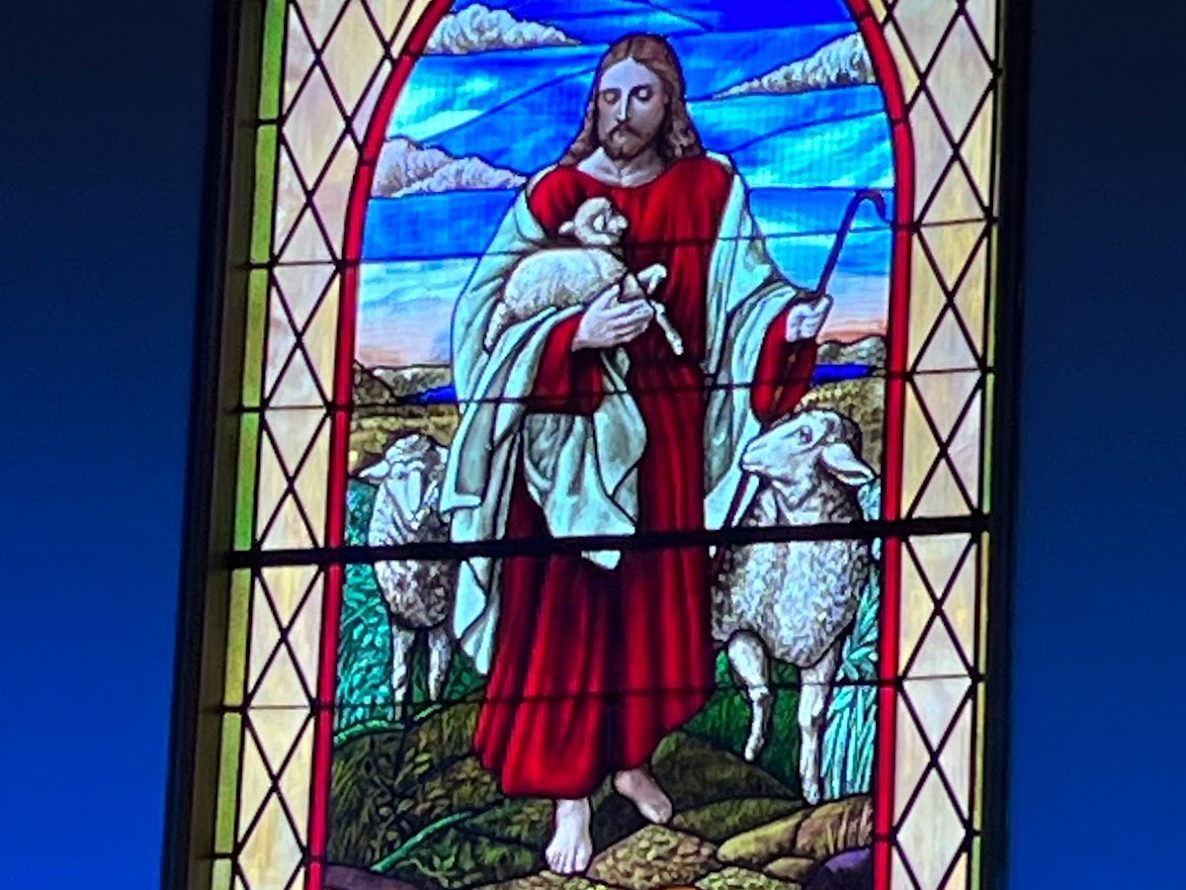
I remembered this as Sunday morning began, having read a meditation to that point, and from years of preaching on the theme on the 4th Sunday of Easter. Then, as we attended church that morning with our son and daughter-in-law at Platt Park Church – Denver, the focal point of the worship space just happens to be a stained glass window of Jesus as the Good Shepherd.
The Good Shepherd – Platt Park Church
I teach a college class, Introduction to Christianity, in which I point out the importance of art in conveying the Christian message over the years. This was especially significant in a largely illiterate world, as the arts could communicate the Gospel message to audiences who lacked the capacity to read. Art reinforces the spoken message. Art reaches senses other forms of proclamation do not.
The shepherd image of God is one Jesus willingly embraced. Like us he prayed the 23rd Psalm. He spoke of sheep and shepherds in his parables and teachings. His entry into the world was celebrated by shepherds. And he embodied the role with his followers.
Jesus understood that the image of a Good Shepherd is personal and intimate. It conveys care, protection and guidance. A shepherd leads the flock, provides for their wellbeing, knows each sheep; and, if necessary, rescues and restores them to the fold.
The sheep know the Good Shepherd’s voice. They trust their shepherd and find contentment and rest in his care.
I considered each of these things on Sunday morning, inspired by the visual that was so prominent in the room. I wondered how often worshippers over the years had taken to heart this non-spoken message even as they listened to the day’s spoken word. Indeed, art has been communicating a message in that sanctuary since the window was first installed.
The worship service on Sunday included the dedication of our granddaughter, which was part of why we were present. As promises were made and affirmed by her parents and the congregation, and a blessing was pronounced over sweet Cora and her parents; I thought of how parenting is a lot like good shepherding. It’s hands on, attentive and protective, yet also encouraging and coaxing. Good parenting, like good shepherding, provides a space for safe growth and exploration. It’s present and available ever ready to step in if needed; but allows for independent formation and discovery as a child grows and matures.
Jesus does all of that and more for we sheep. When we live our lives within proximity to him, we thrive. We can hear his voice. We know he cares. One day we might be the sheep in his arms, another day the one trailing behind. We have all we need. Our souls are restored. The oil of his anointed blessing overflows and runs down upon our life in ways words find difficult to explain.
It’s an image that continues to yield meaning, just as the Good Shepherd window does in the worship space. Just as the image of loving parents holding their infant girl did beneath it. This was the dominant message of the 4th Sunday of Easter for me. For which I am, and I hope you are, thankful.


 danielcash