
Category Archives: Uncategorized

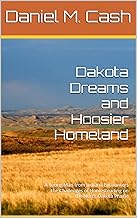
New Book Release: Dakota Dreams and Hoosier Homeland by Daniel M. Cash

My latest book, Dakota Dreams and Hoosier Homeland, a work of historical fiction, has been and is available in paperback and e-reader format on Amazon.com. You can listen to my podcast about the book, featuring the book’s Prologue read in my own voice, on my Substack page. You can also read the Prologue below.

Dakota Dreams and Hoosier Homeland is the story of Clyde and Anna Cash, my paternal grandparents, set in the year 1915 between the communities of Greencastle, Indiana and Arnegard, North Dakota. My grandad Clyde tried his hand at homesteading at about that time in history. And, while I do not know all the particulars to his story, I have researched enough to have created a story that may represent some of the challenges and opportunities he faced. Meanwhile, back home in Indiana, his girl Anna (my grandmother) was patiently, or maybe not so patiently, waiting for Clyde to come to senses and come home. It was fun to imagine their correspondence and decision making.

The Dakotas will always have an imprint on my life, not only because of my grandad’s legacy, but due to my own time there over 100 years later. Writing this book became a way for me to to not only tell part of Clyde and Anna’s story, but to reflect on my own.

Here’s a preview from The Prologue of
Dakota Dreams and Hoosier Homeland:

When Clyde awoke on that early autumn day, he sensed the smell of smoke in the air. By now he had been on the prairie long enough to have heard about the dangers of prairie fires. Following the alert his senses gave him, he quickly went outside to scan the horizon.  To the southwest he saw a plume of smoke rising from above the land. It was the Lucas Johansen place. Lightning from the early morning storm must have ignited the fire.

Clyde wasted no time. He quickly dressed, grabbed an old blanket from his home, stepped into his boots and put on his hat, then high tailed it down the two-track from his place to the Johansen’s.  He jogged more than walked the ½ mile to their farm and saw on his arrival that the fire lay south beyond the homestead and barn lot.

Thankfully, Lucas and his brothers had already harvested the wheat crop earlier in the season, but the fire was making it’s way through the wheat stubble, threatening to move into the portion of the farm where the buildings stood.

Clyde took his place alongside the others, Lucas and Mrs. Johansen; Karl and Hans; Magnus and Marit.  He dipped his blanket into the bucket of water that had been hauled out to the field and commenced to fight back the flames where there was a gap in the line. Soon he was joined by his neighbor and good friend, Thomas O’Brien, who had also seen and smelled the smoke, and come to help.

The danger of prairie fires was something that had been expressed to both Clyde and O’Brien upon their arrival in the region.  Sadie Svennson had been the first to school them on this phenomenon once when they had seen evidence of such a fire off in the distance from Arnegard.

The arid nature of the climate, prevalence of wind, ample availability of surface fuel and ignition caused by lightning from summer storms often came together as a perfect storm for this particular disaster.  Too many homesteaders had been driven to ruin by such a prairie fire in the past, meaning that everyone came to the fore when such an event sparked nearby.  You never knew if you, your family and your farm might be the next victim.

So, in the best sense of the tradition behind the name “Dakota”, you went to help your “friends”.  You became an “ally” on the prairie, looking to assist in any way you could to get the fire under control, or to at least protect the farmer’s home and farm buildings, livestock and equipment.

After a grueling couple of hours fighting back the flames, the crew working against the Lucas’ Johansen prairie fire got the upper hand.  Assisted by the decline of the wind and consummation of the available fuel, the fire began to play out.  The fact that Karl and Hans had taken their work horses and plowed firebreaks into the field was likely the ultimate difference between winning and losing that day.

Clyde was grateful he had been able to lend a hand. But the event gave him pause. Once again, he was mindful of just how difficult this life on the northern prairie could be. There were so many challenges that could arise – insects, fire, wind, storms, drought.  He knew with winter on the horizon that some of the most challenging days were still to come.

“Come to de house for a drink of vater, Clyde Cash”, called Mrs. Johansen. “Ve vant to thank ye for coming to our aid today.”

So, Clyde joined the others to quench his thirst.  Mrs. Johansen brought out some sour dough bread with jam, as well. And the soot covered homesteaders, from oldest to youngest paused to give thanks for God’s protection and deliverance that day.

This was Lucas’ Johansen’s prayer:

“Ve tank dee Lord God for die deliverance. Yee brought us friends and family to fight back de flames and save our home. Indeed, as your Good Book says, ‘de flame sal not consume you’.”

As he went back home to pick up the chores of the day on his own homestead, Clyde continued to marvel at his neighbor’s demeanor.  The devout Lutheran Norwegian was something of an enigma to Clyde. He could be gruff, blunt and even standoffish. But other times his true metal and character, including his faith, shone about as bright as anything Clyde had experienced. 

Thinking then of the others who were part of that morning’s fire fighting crew, Clyde smiled to himself about the diverse cast of characters he had met on the North Dakota prairie. He knew he had another story to write to Anna about in his next letter.

© Daniel M. Cash 2025

You can place your order for the paper back or e-book version of Dakota Dreams and Hoosier Homeland now.

For more information or to receive email notices about my writing you can subscribe to my blog or substack page.

2 Comments

Filed under Christian Faith, Community, Family, Passageways, Uncategorized

Why Excavation is Important in Leadership

I have always found the practice of archeology interesting.  I admire the patience and craft of those who carefully dig and unearth the evidence of prior civilizations or chapters of current ones.  It’s careful, detailed work that can reveal insight and evidence of what life was like then, helping inform how life can be lived now. By examining the ruins and relics of people who lived years before, we come to understand not only the challenges and opportunities they faced, but also how those very issues have shaped humankind in the years that followed. 

When I applied this thinking to my craft and vocational history of pastoral ministry it generally proved helpful. By doing some archeological like work, examining and studying the contributions of those who lived and led before I ever arrived, I came to know and appreciate the history of the congregation I was trying to partner with and lead. Looking at prior historical records, talking with people who had been present during prior chapters, and gaining insight into what life was like in that community decades prior, demonstrated how patterns and culture was built that is still evident today.

In like manner, as a leader, this practice makes you aware of the importance of giving your best as you attempt to build on that legacy by not repeating similar mistakes, but displaying a capacity to learn, adapt and contribute in such a way that is for the good of all – including those who will one day follow you.

Here’s how the Apostle Paul speaks to this issue in some of his writing:


By the grace God has given me, I laid a foundation as a wise builder, and
someone else is building on it. But each one should build with care. 11 For no one can lay any foundation other than the one already laid, which is Jesus Christ. 12 If anyone builds on this foundation using gold, silver, costly stones, wood, hay or straw, 13 their work will be shown for what it is, because the Day will bring it to light. It will be revealed with fire, and the fire will test the quality of each person’s work. 14 If what has been built survives, the builder will receive a reward. 15 If it is burned up, the builder will suffer loss but yet will be saved—even though only as one escaping through the flames.
(I Corinthians 3:10-15 NIV)

In pastoral ministry you are almost always building on another’s foundation.  You are adding another layer to the work of those who have gone before. One day the archeologist historians who conduct digs will find layer upon layer of work in the artifacts and remains, including your contributions. Some layers might be thicker or more productive and meaningful; others slimmer or briefer.  But consistently – whether by intention or not – they each benefit from the foundation work that came before them.  Should they choose to try and eradicate that work, they would weaken the overall structure. Should they choose to improve upon it – or stabilize it & then add to it – they would benefit the structure.

What’s true in churches, regarding this building on prior foundations, is also true in other institutions, including industry, academia and government. Occasionally a leader will come along who displays no regard whatsoever for the foundation or layers of work that preceded him. (Could be “her”, but let’s face it this type of arrogance is most often male!)  This arrogant leader, who tends to believe he has all the answers, then proceeds to dismantle everything that has come before.  And, to the peril of the institution and it’s people, the result is to severely weaken the overall structure. Why? No attention was paid to learning from the layers of prior chapters. History was deemed an insufficient teacher, or too boring, perhaps requiring study and reading – something an arrogant leader may feel he has no time to devote toward.

But rest assured, archeologists would probably concur, this leader’s efforts will also one day lay in the rubble of relics and artifacts to be studied. Perhaps they will be found in the digs of a civilization that failed and has fallen because of it’s disregard for its foundation, or its arrogant assumption that one can build without a foundation.  Time will tell – as it almost always has a way of doing.

© 2025 Daniel M. Cash   

For more of my work, including a weekly podcast “The Cash cache” go to : https://cashdan.substack.com/

Leave a comment

Filed under Christian Faith, Leadership, Ministry, Pastors, Uncategorized, What I Am Learning

Two Parades (A Palm Sunday and Holy Week Meditation)

This is a week when we commemorate two parades separated by just four days. The first occurred on a Sunday, the next  on a Friday. Sunday’s parade was a most unlikely one.  Spontaneous in nature, it announced the arrival of The King of Kings.

His entry into the city was marked with “Hosannas” and the waving of palm branches. This, coupled with the makeshift red carpet of coats and cloaks, served to announce an inauguration. A leader of true significance was entering David’s City, an heir from the royal line.

Recognition came from the masses, those of common estate who were filled with hope and roused to action. Might this be the beginning of the end?  The end of occupation? The end of Roman rule? The end of unjust taxation and oppression?

What kind of king can deliver such things? A revolutionary, an upstart who overturns tables and drives out corrupt moneychangers. Yet this King was humble, riding in on a donkey’s colt, not a noble steed. His countenance was sorrowful, as if he knew what others did not. “O Jerusalem, Jerusalem!  How I have longed to gather you as a hen does her chicks.”  From the parade’s elevated origin point above the city he wept over its past and present.

Soon, he knew, the very voices raised to his honor would be crying for his death. “Hosanna” would fade and be overmatched by “Crucify him!” 

Friday’s procession led the soon to be crucified Jesus down the Via Dolorosa (the way of suffering). It was a procession to Golgotha, the place of the Skull, where executions of traitors were carried out. This procession also drew the attention of many, but for different reasons. For some it seemed the completion of a usurpers false promises. For others it seemed the end of what had once been a great hope.

Derision, mockery and tears took the place of palm branches. There was no runway of any kind of carpet. The disdain and shaming would continue throughout the journey and onto the cross. “You saved others, save yourself if you are the Son of God”.

The Palm Sunday parade had but one entry. Jesus was both the Grand Marshall and sole exhibit.  The Good Friday procession would feature a beaten Christ, accompanied by the power of Rome in the form of a military escort.

Two parades separated by just a few days. That’s how fast hope can be dashed, how fickle public opinion can be swayed. In just a few days, promise yields to punishment. 

It’s important that we remember these two parades. They both reveal the identity of the Christ (Triumphant Savior and Suffering Servant). Both can be true at once.

They also reveal something of human nature. Many, maybe most, want a heroic Messiah who demonstrates power and decisive action, one who is the pride and joy of Sunday.  But what’s needed is also the humble servant of Friday who gives up his life that we might live.

Real, heroic leadership is both these things and much more. Don’t let the pretenders fool you. Cruelty, hatred, force, nor pompous proclamation do not a worthy king make.  Give me the one on the donkey, the one who carries the cross. He is the only King we need.

© 2025 Daniel M. Cash

1 Comment

Filed under Uncategorized

What I have learned being in the minority

I believe everyone should experience being in the minority at times. It has much to teach us. Admittedly, I write this as one who has spent almost the entirety of my life as part of the privileged majority. If that seems too much of a “woke” statement for you, hear me out. I am a white, male American who has a higher education and has occupied positions of authority others often defer to in respect for the office if not the occupant. This alone has positioned me as a person of privilege and influence most of my life. It is a position I’ve occupied somewhat by fate, having been born into my culture and socioeconomic state. But I have also built on the foundation I was born into with certain efforts of self-improvement. While I try not to take my status for granted, or abuse it, I begin this reflection, admitting it.

That said, there have been several times in my life in which I’ve found myself in the minority. Almost always these have been learning opportunities, causing me to pause and reflect on life from the viewpoint of another. I’d like to share just a few of them.

Mission trips: I have been blessed to have participated in short-term mission trips to Mexico, Haiti, and Chile as part of ministry groups I’ve led or joined. While these trips took place in the security of like-lived groups of people, and under the direction of western missionaries sensitive to our places of origin, each offered moments in which I became acutely aware of my minority status.

Continue reading

1 Comment

Filed under Christian Faith, Leadership, Ministry, Uncategorized, What I Am Learning

The Truth Will Set You Free

Jesus said, “If you continue in my word, you are truly my disciples; and you will know the truth, and the truth will make you free.” (John 8:31-32 NRSV)

When I worked in conflict mediation in congregational settings I learned that in the absence of truth, people quickly made up their own truth. In other words, unless the congregation’s leaders were willing to be honest about whatever the conflict issue was, congregants were quick to supply their own version of events. This version, whether it was accurate or not, then became “truth” to those who adhered to it. It is always better, even if things are ugly or messy, to share the truth than try and shield others from it. Those who bury or hide the truth from others will usually wish they hadn’t. Once an “untruth” has taken form and set up like finished concrete, it’s pretty difficult to dislodge.

I’m thinking about this, as well as the maxim so often ascribed to Jesus – “The truth will set you free” – because in our world today it seems to me “truth” has become a rare commodity. Perhaps this has always been the case to some extent among those who seek to manipulate and maneuver people into their way of thinking or toward adoption of their agenda. But it seems that the disregard for truth, in favor of lies, untruths, partial truths or “my own truth”, has exponentially multiplied in contemporary society. Political leaders unashamedly espouse untruths repeatedly to gain favor with the electorate. Elected officials acquiesce to parsing words over versions of the truth. Even religious leaders look the other way when it comes to the propulsion of truth’s missiles being lobbed and landed.

Continue reading

Leave a comment

Filed under Christian Faith, Hope, Leadership, Ministry, Passageways, Pastors, Spiritual Formation, Uncategorized, What I Am Learning