
Category Archives: What I Am Learning

The Family Undertaker

It’s funny where you mind takes you if you follow it – at least it can be funny how my mind works in this way.  Take this morning. I was out for a bike ride, following one of my favorite routes north on the People Trail and then out in the country, riding some of the county roads. I noticed that someone’s cat had lost it’s life on the road, likely hit by a car as it crossed in front of it.

It was a pretty cat, a kind of grey tabby, and I immediately began to wonder who it had belonged to. I imagined some young children who might be sad about losing their cat in this way, maybe their dad seeing it on the road and stopping to scoop it up, take it home and bury it.

The burial of family pets and animals can be a rite of passage for children.  I for one don’t favor sheltering children from these happenings, as death is a natural part of life, and grief is central to the human experience. Better to walk with them and help them process it from a more honest and healthy perspective. That’s the path we always took with our own pets and family. All of this led me to reflect on my own childhood, and how it was that I inherited the role of the Family Undertaker.

I grew up on a five-acre plot of land, in a rural part of the county, where we had pets and animals. There was always a family dog, and a variety of cats, sometimes with kittens.  In addition, there were the dogs and cats of neighbors that would come onto our property to visit.

We also had a pond, with a fenced in meadow of land around it that we called the Sheep Lot. You guessed it, there were sheep that dwelt in that plot of land, as well as a couple of goats, and a plethora of ducks.  The ducks would nest in the Spring and often hatch broods of ducklings, which became fodder for the snapping turtles that lived in the pond, or the cats that prowled the banks. There was a simple block building that served as shelter for the sheep in the winter or rainy weather.  It was often lined with straw for bedding. I remember once walking into that building to find a fox with one of our ducks in it’s mouth staring back at me.

This was the life of my childhood. The animals, including the ducks and sheep, were as much pets to me as the dog and cats.  And, over the course of some years, I learned that animals, like people, die. Sometimes it’s due to accidents.  Sometimes it’s due to old age. When it happens, there is usually a discovery of the death (the fox with the duck, the duckling with a turtle bite through it’s breast, the cat on the road), followed by a time of mourning the loss, and the necessity of disposal (burial) of the body.

We used a portion of the Sheep Lot for the burials.  And, more often than not, once I was old enough, I was the one who did the burying. I buried ducks, cats, a racoon, dead birds, one of the sheep (that was a big hole), and maybe one of our dogs.

I developed my own technique for grave preparation.  I learned to cut and skim the sod off the top of the grave so that it could be reapplied later.  I measured the size of hole that would be needed, given the size of animal to be buried. Then I was sure to dig a grave deep enough that the deceased would be given an eternal rest free from any vermin who might come and dig it up.  This was important, I learned that grave robbers live among the wilds of the world.

I had to keep track of where prior graves existed in our version of a pet cemetery, though I never did mark the graves. One didn’t want to double dip, so to speak. So, I carried a kind of mental map of the area in my head. “That’s where I buried the sheep. That’s where I buried Tiger my cat. That’s where Buster lies.”  It got a bit crowded and I had to keep expanding the borders. But it was a task I took on with pride and a stoic sort of calling. I was the family undertaker.

Looking back, all of this seems to have been training for the professional role I would later occupy as a pastor, and now hospital chaplain.  Becoming comfortable with death, and the appropriate rites of grief and burial, may have prepared me, in part, to stand at the graveside of numerous people over the years as I officiated graveside funerals and led committal services.

I’ve lost track of how many times I have done this. I know that in my last pastorate alone I officiated over 130 funerals. Now, as a hospital chaplain, it’s rare to work a shift without a death.  I respond when notified, often meeting the deceased and family for the first time. I extend my condolences to the family, ask them to share with me about the deceased, offer words of comfort, and share a prayer of thanksgiving and commendation if they desire.  It’s an important ministry, helping in those transitional moments, to acknowledge the gift of a life and the sorrow of a death, and the continuation of living for those who remain. I do think I learned some of these things firsthand in my family undertaker role, taking care of the deceased pets and animals of my childhood.

We continued the tradition as we said goodbye to our pets with our own children and grandchildren.  My daughters companioned me to the vet as we had two beloved Corgi’s put down over the years, their quality of life and suffering demanding such an act of mercy. I buried their cremated remains alongside the planting of trees on our property. The grandsons assisted me with the last burial and that tree is known as Boomer’s tree. It was kind of a full circle moment.

Cemeteries are sacred places. I have been to many of them to perform last rites of passage. I have some favorites.  There’s a beautiful cemetery in Vernon, Indiana.  And it’s hard to beat the Hope Moravian cemetery for it’s setting. Flatrock Baptist, not far from our home is nice. Maybe the bests view I ever had in a cemetery was in Snohomish, Washington, standing graveside on a hill overlooking the Snohomish River, with the Olympic mountains off in the distance.

But it all started with that Sheep Lot cemetery of my childhood.  And it all came back to me because I passed some family’s beautiful kitty whose life had ended on the county road.  It’s funny where your mind will take you, if you let it.

Daniel M. Cash © 2025
1 Comment

Filed under Christian Faith, Cycling, Family, Ministry, Pastors, What I Am Learning

My First Spiritual Directors

Maybe you have heard of the Christian practice of spiritual direction?  It has been in existence for quite some time and has found both renewal and expansion in recent years. While the roots of this practice are biblical, modeled in the mentorship and guidance we see in relationships like those of Jethro and Moses, or Eli and Samuel, the formation of the practice really originates in monasticism.  During the days of the Desert Fathers and Mothers it was common for Christian pilgrims to come to them for direction.  And the direction they were seeking was spiritual in nature.

In their book The Practice of Spiritual Direction (Barry & Conolly,1986) the authors offer this definition: “Spiritual direction is help given by one Christian to another which enables that person to pay attention to God’s personal communication to him or her, to respond to this personally communicating God, to grow in intimacy with this God, and to live out the consequences of the relationship.” 

Spiritual direction involves both the director and directee or pilgrim.  It centers on the spiritual director’s ability to create space for their directee to explore what they may already know but have found hard to access. In this sense, the work is relational as well as prayerful and reflective in nature.  It’s work that moves at its own pace of discovery, not to be rushed, yet purposeful and guided.

I have had two occasions in which to benefit from a spiritual direction relationship.  One was associated with a Sabbatical.  I built into my plan and budget a sequence of spiritual direction sessions upon the sabbatical’s end to unpack and reflect upon the experience and what lay ahead.  I met with my spiritual director face to face about every four to six weeks for about an hour, during which time she would gently help guide me through whatever question, event or exploration I felt was brimming in my spiritual life.  It was a rich time of discovery and exploration, centered in listening and paying attention to God’s communication.  The insightful questions and observation my director raised were poignant ways of drawing my attention to my relationship with the Lord.

Continue reading

Leave a comment

Filed under Christian Faith, Ministry, Pastors, Spiritual Formation, What I Am Learning

Why Excavation is Important in Leadership

I have always found the practice of archeology interesting.  I admire the patience and craft of those who carefully dig and unearth the evidence of prior civilizations or chapters of current ones.  It’s careful, detailed work that can reveal insight and evidence of what life was like then, helping inform how life can be lived now. By examining the ruins and relics of people who lived years before, we come to understand not only the challenges and opportunities they faced, but also how those very issues have shaped humankind in the years that followed. 

When I applied this thinking to my craft and vocational history of pastoral ministry it generally proved helpful. By doing some archeological like work, examining and studying the contributions of those who lived and led before I ever arrived, I came to know and appreciate the history of the congregation I was trying to partner with and lead. Looking at prior historical records, talking with people who had been present during prior chapters, and gaining insight into what life was like in that community decades prior, demonstrated how patterns and culture was built that is still evident today.

In like manner, as a leader, this practice makes you aware of the importance of giving your best as you attempt to build on that legacy by not repeating similar mistakes, but displaying a capacity to learn, adapt and contribute in such a way that is for the good of all – including those who will one day follow you.

Here’s how the Apostle Paul speaks to this issue in some of his writing:


By the grace God has given me, I laid a foundation as a wise builder, and
someone else is building on it. But each one should build with care. 11 For no one can lay any foundation other than the one already laid, which is Jesus Christ. 12 If anyone builds on this foundation using gold, silver, costly stones, wood, hay or straw, 13 their work will be shown for what it is, because the Day will bring it to light. It will be revealed with fire, and the fire will test the quality of each person’s work. 14 If what has been built survives, the builder will receive a reward. 15 If it is burned up, the builder will suffer loss but yet will be saved—even though only as one escaping through the flames.
(I Corinthians 3:10-15 NIV)

In pastoral ministry you are almost always building on another’s foundation.  You are adding another layer to the work of those who have gone before. One day the archeologist historians who conduct digs will find layer upon layer of work in the artifacts and remains, including your contributions. Some layers might be thicker or more productive and meaningful; others slimmer or briefer.  But consistently – whether by intention or not – they each benefit from the foundation work that came before them.  Should they choose to try and eradicate that work, they would weaken the overall structure. Should they choose to improve upon it – or stabilize it & then add to it – they would benefit the structure.

What’s true in churches, regarding this building on prior foundations, is also true in other institutions, including industry, academia and government. Occasionally a leader will come along who displays no regard whatsoever for the foundation or layers of work that preceded him. (Could be “her”, but let’s face it this type of arrogance is most often male!)  This arrogant leader, who tends to believe he has all the answers, then proceeds to dismantle everything that has come before.  And, to the peril of the institution and it’s people, the result is to severely weaken the overall structure. Why? No attention was paid to learning from the layers of prior chapters. History was deemed an insufficient teacher, or too boring, perhaps requiring study and reading – something an arrogant leader may feel he has no time to devote toward.

But rest assured, archeologists would probably concur, this leader’s efforts will also one day lay in the rubble of relics and artifacts to be studied. Perhaps they will be found in the digs of a civilization that failed and has fallen because of it’s disregard for its foundation, or its arrogant assumption that one can build without a foundation.  Time will tell – as it almost always has a way of doing.

© 2025 Daniel M. Cash   

For more of my work, including a weekly podcast “The Cash cache” go to : https://cashdan.substack.com/

Leave a comment

Filed under Christian Faith, Leadership, Ministry, Pastors, Uncategorized, What I Am Learning

The Image of the Good Shepherd

This past Sunday in the Church year was the 4th Sunday of Easter, also traditionally known as Good Shepherd Sunday.  This means that most of the lectionary readings for the day contain some shepherd type reference to God or Jesus.  For example, this year’s readings included: Psalm 23 (The Lord is my shepherd . . .), Revelation 5:11-14 (Worthy is the Lamb), and John 10 (I am the Good Shepherd).

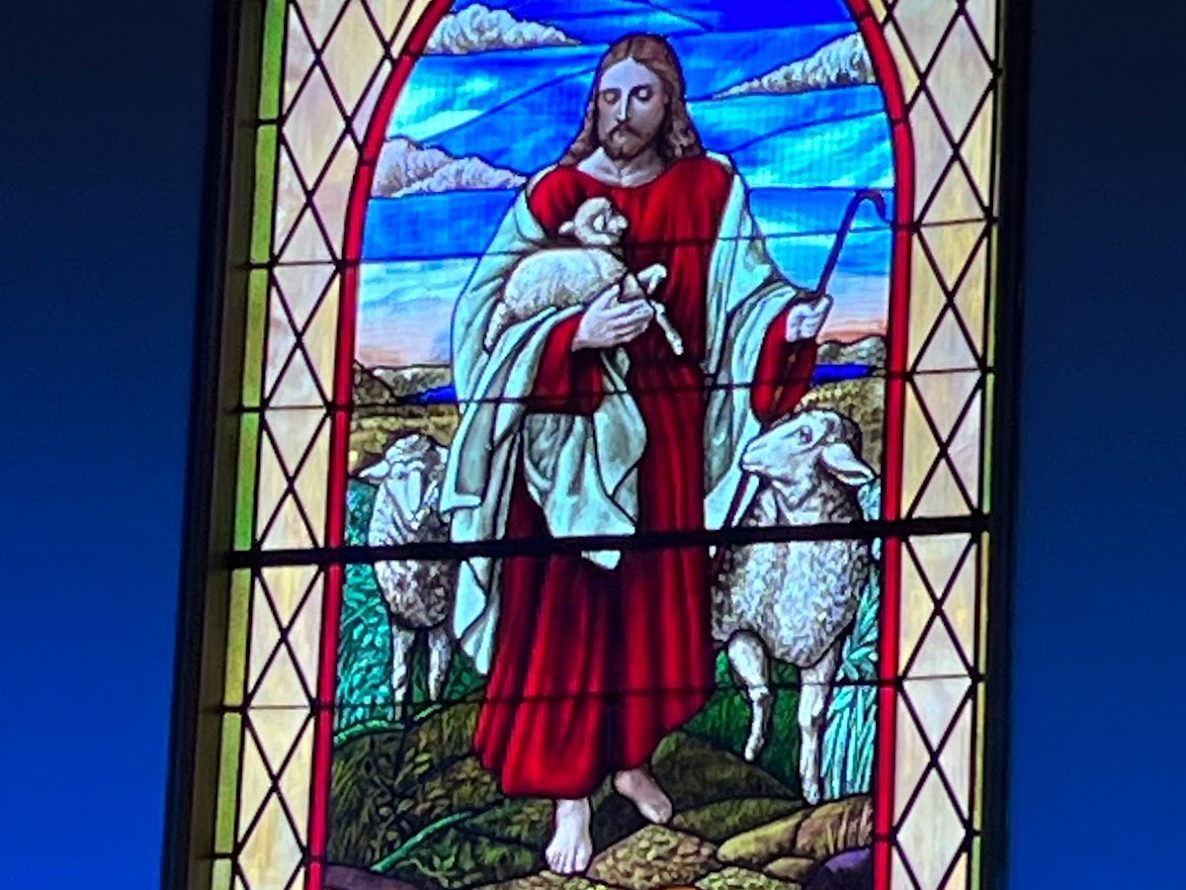
I remembered this as Sunday morning began, having read a meditation to that point, and from years of preaching on the theme on the 4th Sunday of Easter. Then, as we attended church that morning with our son and daughter-in-law at Platt Park Church – Denver, the focal point of the worship space just happens to be a stained glass window of Jesus as the Good Shepherd.

The Good Shepherd – Platt Park Church

I teach a college class, Introduction to Christianity, in which I point out the importance of art in conveying the Christian message over the years. This was especially significant in a largely illiterate world, as the arts could communicate the Gospel message to audiences who lacked the capacity to read. Art reinforces the spoken message. Art reaches senses other forms of proclamation do not.

The shepherd image of God is one Jesus willingly embraced. Like us he prayed the 23rd Psalm. He spoke of sheep and shepherds in his parables and teachings. His entry into the world was celebrated by shepherds. And he embodied the role with his followers.

Jesus understood that the image of a Good Shepherd is personal and intimate. It conveys care, protection and guidance. A shepherd leads the flock, provides for their wellbeing, knows each sheep; and, if necessary, rescues and restores them to the fold.

The sheep know the Good Shepherd’s voice. They trust their shepherd and find contentment and rest in his care. 

I considered each of these things on Sunday morning, inspired by the visual that was so prominent in the room. I wondered how often worshippers over the years had taken to heart this non-spoken message even as they listened to the day’s spoken word. Indeed, art has been communicating a message in that sanctuary since the window was first installed.

The worship service on Sunday included the dedication of our granddaughter, which was part of why we were present. As promises were made and affirmed by her parents and the congregation, and a blessing was pronounced over sweet Cora and her parents; I thought of how parenting is a lot like good shepherding. It’s hands on, attentive and protective, yet also encouraging and coaxing. Good parenting, like good shepherding, provides a space for safe growth and exploration. It’s present and available ever ready to step in if needed; but allows for independent formation and discovery as a child grows and matures.

Jesus does all of that and more for we sheep. When we live our lives within proximity to him, we thrive. We can hear his voice. We know he cares. One day we might be the sheep in his arms, another day the one trailing behind. We have all we need. Our souls are restored. The oil of his anointed blessing overflows and runs down upon our life in ways words find difficult to explain.

It’s an image that continues to yield meaning, just as the Good Shepherd window does in the worship space. Just as the image of loving parents holding their infant girl did beneath it. This was the dominant message of the 4th Sunday of Easter for me.  For which I am, and I hope you are, thankful.

© Daniel M. Cash 2025

Leave a comment

Filed under Christian Faith, Ministry, Pastors, Spiritual Formation, What I Am Learning

Overcoming One’s “Dark Night of the Soul”

Recently the world news has focused attention on the passing of Pope Francis, whose death followed a 12-year ministry as head of the Roman Catholic Church. Though not a Catholic, I found Pope Francis to be an interesting and inspiring Christian leader. I appreciated his humble posture and more open stance on issues, as well as his generosity toward all people.

Not too long ago I read his biography “Life: My Story Through History”. In this book Francis referenced a two-year period of ministry he referred to as a “dark night”. This occurred in the 1990’s when he was removed from his position as a provincial of the Jesuit order in Argentina and sent to a rural parish. It was something of an exile which he called his “dark night of the soul” and a “great interior crisis”. Pope Francis did not offer much more than those comments on these two years of his remarkable life, but they clearly formed and shaped him. According to some he emerged from that time a kinder, humbler person; like the one who was so fondly remembered over the past days.

This is what can take place as a result of enduring what in spiritual terms is often called the “dark night of the soul”. The phrase is attributed to Saint John of the Cross, a 16th Century Spanish Carmelite friar and mystic who wrote a poem by that title. By definition, such an experience is “a period of spiritual desolation in which all sense of consolation is removed.” Plainly put, the dark night is a difficult, painful period in one’s life.

I suspect that many, if not most, spiritual leaders go through their own version of a dark night at some point. It might be a particularly difficult time of ministry during which your leadership is questioned, or you are questioning your call or faith. Dark nights can be self-imposed or just creep up on you. They are not limited to those in leadership. Any Christ follower can be susceptible to a dark night where there are more questions than answers and more silence than affirmations.

My own experience with this is still fresh. In the later part of 2022 I made a ministry transition, leaving a pastorate of fifteen years for another opportunity. Looking back, I can see that while I was correct that it was time to step away from that pastorate, the call that I pursued was of my own forcing. In other words, I pursued a job that was not a good fit, bringing on my own dark night experience. There was some arrogance and willfulness in my saying “yes” to that call, and I regret any pain or confusion it may have caused. I left that position after just three months.

What ensued was a very lonely time of introspection. The dark night followed me and, if I’m honest, endured another couple of years. I did not question my faith, but I did face the humbling experience of facing my failure and self-induced disappointment. There’s something about falling on your face that is humiliating. When you do in front of an audience of your peers, including those who questioned your decision and would probably like to say “I told you so” – that is truly mortifying. But, if you can dust off the humiliation and swallow your pride, so as to engage in the emptying work of prayer and formation, good can come from the void of silence and darkness.

Throughout my own dark night experience God continued to place opportunities of service before my path that have resulted in a reaffirmation of my call and gifts. I would call these opportunities part of my formation or re-formation. Hopefully they have caused me to be a gentler, kinder version of myself.

From time to time I have a flashback to my dark night days, feeling the emotions and disappointment of that time anew. Thankfully these experiences are becoming fewer and less frequent. But I think they remain as a means of my not forgetting the work God seeks to do in and through me today.

It’s a bit daunting to write about this from such a personal place of discovery, but I do so in hope that it may speak to someone else. If you are in that proverbial dark night place, please know that you are not alone. Many, maybe most, others have been or are there too. It’s not the end of things. There is a repeated theme in the Bible of wilderness. Jesus spent time in the wilderness, and Israel labored there. Why should we expect to avoid it? The important thing is not that we were in exile, but that we emerge from it – strengthened, changed, and open to continue in God’s grace and love.

© Daniel M. Cash 2025

If you are interested in reading or listening to more of my work, I offer a podcast called “The Cash cache” through Substack that features many of my stories and reflections written over the years in my own voice.

1 Comment

Filed under Christian Faith, Hope, Ministry, Pastors, What I Am Learning