
Why Excavation is Important in Leadership

I have always found the practice of archeology interesting.  I admire the patience and craft of those who carefully dig and unearth the evidence of prior civilizations or chapters of current ones.  It’s careful, detailed work that can reveal insight and evidence of what life was like then, helping inform how life can be lived now. By examining the ruins and relics of people who lived years before, we come to understand not only the challenges and opportunities they faced, but also how those very issues have shaped humankind in the years that followed. 

When I applied this thinking to my craft and vocational history of pastoral ministry it generally proved helpful. By doing some archeological like work, examining and studying the contributions of those who lived and led before I ever arrived, I came to know and appreciate the history of the congregation I was trying to partner with and lead. Looking at prior historical records, talking with people who had been present during prior chapters, and gaining insight into what life was like in that community decades prior, demonstrated how patterns and culture was built that is still evident today.

In like manner, as a leader, this practice makes you aware of the importance of giving your best as you attempt to build on that legacy by not repeating similar mistakes, but displaying a capacity to learn, adapt and contribute in such a way that is for the good of all – including those who will one day follow you.

Here’s how the Apostle Paul speaks to this issue in some of his writing:


By the grace God has given me, I laid a foundation as a wise builder, and
someone else is building on it. But each one should build with care. 11 For no one can lay any foundation other than the one already laid, which is Jesus Christ. 12 If anyone builds on this foundation using gold, silver, costly stones, wood, hay or straw, 13 their work will be shown for what it is, because the Day will bring it to light. It will be revealed with fire, and the fire will test the quality of each person’s work. 14 If what has been built survives, the builder will receive a reward. 15 If it is burned up, the builder will suffer loss but yet will be saved—even though only as one escaping through the flames.
(I Corinthians 3:10-15 NIV)

In pastoral ministry you are almost always building on another’s foundation.  You are adding another layer to the work of those who have gone before. One day the archeologist historians who conduct digs will find layer upon layer of work in the artifacts and remains, including your contributions. Some layers might be thicker or more productive and meaningful; others slimmer or briefer.  But consistently – whether by intention or not – they each benefit from the foundation work that came before them.  Should they choose to try and eradicate that work, they would weaken the overall structure. Should they choose to improve upon it – or stabilize it & then add to it – they would benefit the structure.

What’s true in churches, regarding this building on prior foundations, is also true in other institutions, including industry, academia and government. Occasionally a leader will come along who displays no regard whatsoever for the foundation or layers of work that preceded him. (Could be “her”, but let’s face it this type of arrogance is most often male!)  This arrogant leader, who tends to believe he has all the answers, then proceeds to dismantle everything that has come before.  And, to the peril of the institution and it’s people, the result is to severely weaken the overall structure. Why? No attention was paid to learning from the layers of prior chapters. History was deemed an insufficient teacher, or too boring, perhaps requiring study and reading – something an arrogant leader may feel he has no time to devote toward.

But rest assured, archeologists would probably concur, this leader’s efforts will also one day lay in the rubble of relics and artifacts to be studied. Perhaps they will be found in the digs of a civilization that failed and has fallen because of it’s disregard for its foundation, or its arrogant assumption that one can build without a foundation.  Time will tell – as it almost always has a way of doing.

© 2025 Daniel M. Cash   

For more of my work, including a weekly podcast “The Cash cache” go to : https://cashdan.substack.com/
Leave a comment

Filed under Christian Faith, Leadership, Ministry, Pastors, Uncategorized, What I Am Learning

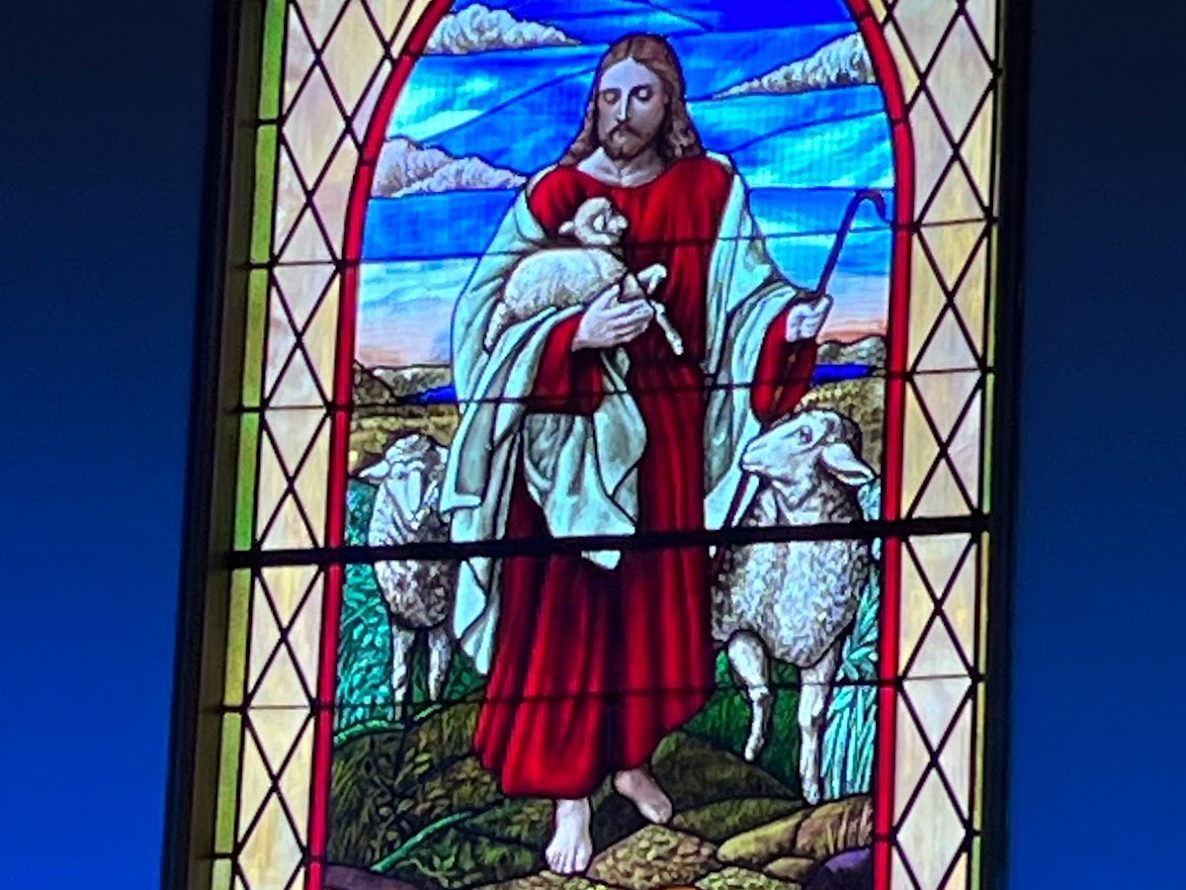
The Image of the Good Shepherd

This past Sunday in the Church year was the 4th Sunday of Easter, also traditionally known as Good Shepherd Sunday.  This means that most of the lectionary readings for the day contain some shepherd type reference to God or Jesus.  For example, this year’s readings included: Psalm 23 (The Lord is my shepherd . . .), Revelation 5:11-14 (Worthy is the Lamb), and John 10 (I am the Good Shepherd).

I remembered this as Sunday morning began, having read a meditation to that point, and from years of preaching on the theme on the 4th Sunday of Easter. Then, as we attended church that morning with our son and daughter-in-law at Platt Park Church – Denver, the focal point of the worship space just happens to be a stained glass window of Jesus as the Good Shepherd.

The Good Shepherd – Platt Park Church

I teach a college class, Introduction to Christianity, in which I point out the importance of art in conveying the Christian message over the years. This was especially significant in a largely illiterate world, as the arts could communicate the Gospel message to audiences who lacked the capacity to read. Art reinforces the spoken message. Art reaches senses other forms of proclamation do not.

The shepherd image of God is one Jesus willingly embraced. Like us he prayed the 23rd Psalm. He spoke of sheep and shepherds in his parables and teachings. His entry into the world was celebrated by shepherds. And he embodied the role with his followers.

Jesus understood that the image of a Good Shepherd is personal and intimate. It conveys care, protection and guidance. A shepherd leads the flock, provides for their wellbeing, knows each sheep; and, if necessary, rescues and restores them to the fold.

The sheep know the Good Shepherd’s voice. They trust their shepherd and find contentment and rest in his care. 

I considered each of these things on Sunday morning, inspired by the visual that was so prominent in the room. I wondered how often worshippers over the years had taken to heart this non-spoken message even as they listened to the day’s spoken word. Indeed, art has been communicating a message in that sanctuary since the window was first installed.

The worship service on Sunday included the dedication of our granddaughter, which was part of why we were present. As promises were made and affirmed by her parents and the congregation, and a blessing was pronounced over sweet Cora and her parents; I thought of how parenting is a lot like good shepherding. It’s hands on, attentive and protective, yet also encouraging and coaxing. Good parenting, like good shepherding, provides a space for safe growth and exploration. It’s present and available ever ready to step in if needed; but allows for independent formation and discovery as a child grows and matures.

Jesus does all of that and more for we sheep. When we live our lives within proximity to him, we thrive. We can hear his voice. We know he cares. One day we might be the sheep in his arms, another day the one trailing behind. We have all we need. Our souls are restored. The oil of his anointed blessing overflows and runs down upon our life in ways words find difficult to explain.

It’s an image that continues to yield meaning, just as the Good Shepherd window does in the worship space. Just as the image of loving parents holding their infant girl did beneath it. This was the dominant message of the 4th Sunday of Easter for me.  For which I am, and I hope you are, thankful.

© Daniel M. Cash 2025

Leave a comment

Filed under Christian Faith, Ministry, Pastors, Spiritual Formation, What I Am Learning

Overcoming One’s “Dark Night of the Soul”

Recently the world news has focused attention on the passing of Pope Francis, whose death followed a 12-year ministry as head of the Roman Catholic Church. Though not a Catholic, I found Pope Francis to be an interesting and inspiring Christian leader. I appreciated his humble posture and more open stance on issues, as well as his generosity toward all people.

Not too long ago I read his biography “Life: My Story Through History”. In this book Francis referenced a two-year period of ministry he referred to as a “dark night”. This occurred in the 1990’s when he was removed from his position as a provincial of the Jesuit order in Argentina and sent to a rural parish. It was something of an exile which he called his “dark night of the soul” and a “great interior crisis”. Pope Francis did not offer much more than those comments on these two years of his remarkable life, but they clearly formed and shaped him. According to some he emerged from that time a kinder, humbler person; like the one who was so fondly remembered over the past days.

This is what can take place as a result of enduring what in spiritual terms is often called the “dark night of the soul”. The phrase is attributed to Saint John of the Cross, a 16th Century Spanish Carmelite friar and mystic who wrote a poem by that title. By definition, such an experience is “a period of spiritual desolation in which all sense of consolation is removed.” Plainly put, the dark night is a difficult, painful period in one’s life.

I suspect that many, if not most, spiritual leaders go through their own version of a dark night at some point. It might be a particularly difficult time of ministry during which your leadership is questioned, or you are questioning your call or faith. Dark nights can be self-imposed or just creep up on you. They are not limited to those in leadership. Any Christ follower can be susceptible to a dark night where there are more questions than answers and more silence than affirmations.

My own experience with this is still fresh. In the later part of 2022 I made a ministry transition, leaving a pastorate of fifteen years for another opportunity. Looking back, I can see that while I was correct that it was time to step away from that pastorate, the call that I pursued was of my own forcing. In other words, I pursued a job that was not a good fit, bringing on my own dark night experience. There was some arrogance and willfulness in my saying “yes” to that call, and I regret any pain or confusion it may have caused. I left that position after just three months.

What ensued was a very lonely time of introspection. The dark night followed me and, if I’m honest, endured another couple of years. I did not question my faith, but I did face the humbling experience of facing my failure and self-induced disappointment. There’s something about falling on your face that is humiliating. When you do in front of an audience of your peers, including those who questioned your decision and would probably like to say “I told you so” – that is truly mortifying. But, if you can dust off the humiliation and swallow your pride, so as to engage in the emptying work of prayer and formation, good can come from the void of silence and darkness.

Throughout my own dark night experience God continued to place opportunities of service before my path that have resulted in a reaffirmation of my call and gifts. I would call these opportunities part of my formation or re-formation. Hopefully they have caused me to be a gentler, kinder version of myself.

From time to time I have a flashback to my dark night days, feeling the emotions and disappointment of that time anew. Thankfully these experiences are becoming fewer and less frequent. But I think they remain as a means of my not forgetting the work God seeks to do in and through me today.

It’s a bit daunting to write about this from such a personal place of discovery, but I do so in hope that it may speak to someone else. If you are in that proverbial dark night place, please know that you are not alone. Many, maybe most, others have been or are there too. It’s not the end of things. There is a repeated theme in the Bible of wilderness. Jesus spent time in the wilderness, and Israel labored there. Why should we expect to avoid it? The important thing is not that we were in exile, but that we emerge from it – strengthened, changed, and open to continue in God’s grace and love.

© Daniel M. Cash 2025

If you are interested in reading or listening to more of my work, I offer a podcast called “The Cash cache” through Substack that features many of my stories and reflections written over the years in my own voice.

1 Comment

Filed under Christian Faith, Hope, Ministry, Pastors, What I Am Learning

The Gift of a Power Outage

I was working at home the other day when in the early afternoon the power went out. Just like that, no lights, no internet, the home appliances I had started (dishwasher and clothes washer) all stopped working.

My first thought was “Oh no!”. I had some things planned. I was going to record a video lecture for my summer class, do some writing on my laptop, and work through a spreadsheet related to financial planning.

Then I thought, “Oh yes!”. This power outage just might be a gift. Duke Energy had already texted an official notice with projected restoration time – in about three hours. So, sure I could still write and plan on my laptop, it has a good battery function. But instead, I picked up a composition notebook and pen and headed for the screened porch and my favorite chair.

The gentle patter of the Spring rain was palpable as I sat down, notebook in hand. A cool breeze came through. Birds were singing, and the dogwood tree was nearly in full bloom, just in the middle of my line of sight. What a gift this interruption. Not so long as to be terribly inconvenient or troubling, but a break to be savored. To sit, listen, look, observe and reflect.

A squirrel scampers along the top of the neighbor’s fence, while his mate or rival, not sure which, chucks and chortles at him. He stops, as if to consider the message, then silently moves along. Finally, he sits on his back haunches and looks my way. What is he thinking?

A cardinal lands in the upper branches of another neighbor’s recently leafed out tree. She’s busy flitting from branch to branch. There’s some feather preening undertaken, making use of the light rain. It reminds me to put out the bird bath. But that’s a chore that will wait another day. For now, I sit amidst the suburban sounds of nature on a rainy Spring day.

Iris are budding. The miniature lilac bush is deepening in blossomed hues – looks like it did survive that recent freeze. Peonies are forming rounded buds, erect for now, though when in full bloom this rain would weigh them down. Tulips have mostly yielded, following the lead of their daffodil cousins. And the forsythia is now more green in foliage than yellow in blooms.

Just beyond, the garden lies quiet. Some seed planted late last week has yet to germinate and emerge, but with the rain’s call and blessing it will soon do so.

I like taking stock of these things that a power outage has brought to my attention. They are markings of life and change. None of them come with the hum or glow of electrical wattage, and somehow that makes them more wonderful.

A book sits by my chair, along with my trusty Kindle reader. It’s a great afternoon for some reading. But I think not with the backlit E-reader today. No, this window in time, this gift of a luddite afternoon, calls for a hardback with print on paper, read via natural light.

Who knows, a few pages read might induce a nap! That too would be fitting. Lights, the hum of appliances, and noise of electric powered living will resume soon enough. If they don’t, we will light a candle as dusk falls. Maybe we should do that anyway.

© Daniel M. Cash 2025

1 Comment

Filed under Seasons, What I Am Learning

Living Between the Kingdom and Empire

As Christ followers, fresh from the “Alleluias” of Easter’s joy, resume daily routines, will the refueling of Resurrection Day and it’s news be proven to have emboldened us to live as the proverbial “Easter people”? Or will the gravity and bleakness of empire infiltrate our lives and overtake that joyous message? These are the questions I’m thinking about personally as a contemporary disciple of Jesus facing the age-old tension of living between the Kingdom of God and empire of today.

To state it another way, how can the residual effects of full Church sanctuaries, inspiring sermons and the uplifting music of Easter inject us with a booster shot that propels us to live something closer to the “Kingdom of God” than the anxiety and despair of today’s broken imperial system? Perhaps it’s too much to ask, but then again, maybe not.

The Resurrection bespeaks a triumphal death defeating Messiah who calls us into the fullness of abundant and everlasting life. This is life in God’s Kingdom where the reign and rule of the living Jesus is welcomed and celebrated – Christ is Risen!

In this Kingdom living we set aside the restraints and perilous news of the world, in favor of the ways of the living King Jesus. We are released from the magnet pull of overbearing messages via social media and traditional media outlets. Released to spend time with kindred siblings in Christ and focus on the ways of Christ himself. In this release we feel and affirm the defining identity of our “in Christ-ness” that both calls us apart and sends us forth.

Continue reading

Leave a comment

Filed under Christian Faith, Holy Days, Hope, Ministry, Pastors